United States (USA) (English / USD)

August 10, 2026
40-60% Humidity Rule: The Missing Variable Behind Sleep, Immunity, and Productivity
The Missing Indoor Air Quality Variable
So, you’ve created what should be the perfect sleep environment. The bedroom is aired out, slightly cool, completely dark, and quiet. You’ve refined your sleep hygiene too, and even invested in a high-quality mattress and bedding.
And yet, you still wake up uncomfortable. Your throat feels sore. Your nose is dry or congested. Your eyes need drops first thing in the morning. Maybe you’ve even been catching colds more often than you’d expect.
Sleep doesn’t feel fully restorative, even when the numbers—your sleep score, room temperature, and CO2 levels—say it should be. Something doesn’t add up.
Even in a well-ventilated room, one variable can undermine your immune defenses, disrupt sleep, and affect how you feel the next day. That variable is humidity.
For health and comfort, humidity needs to stay within a relatively narrow range—roughly 40–60%. Step outside it, and your body will let you know.
Humidity and The Immune System
Quick fixes like eye drops, nasal sprays, and drinking more water can ease the discomfort dry air causes. But the impact on your body goes deeper, because humidity is directly linked to how your immune system functions.
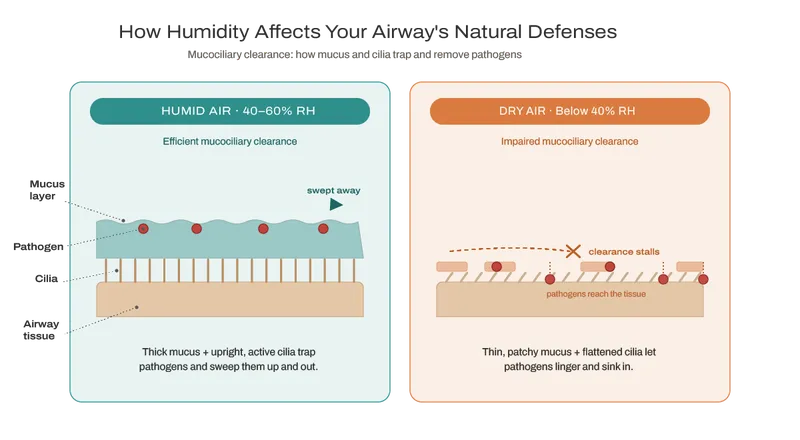
Inside your airways, your body relies on a built-in defense system called mucociliary clearance (MCC). A thin layer of moisture and tiny hair-like structures help trap and remove viruses, bacteria, and particles before they reach deeper into the lungs.
When the air is too dry (below ~40% relative humidity), that system starts to lose efficiency.
The mucus layer becomes thinner, and cilia slow down. Instead of being cleared out, pathogens remain in your airways longer and have a better chance of taking hold. Research shows this is one of the reasons respiratory infections like the flu spread more easily in dry conditions, particularly during colder seasons.
But the impact doesn’t stop there.
The 40-60% Humidity Rule and Sleep
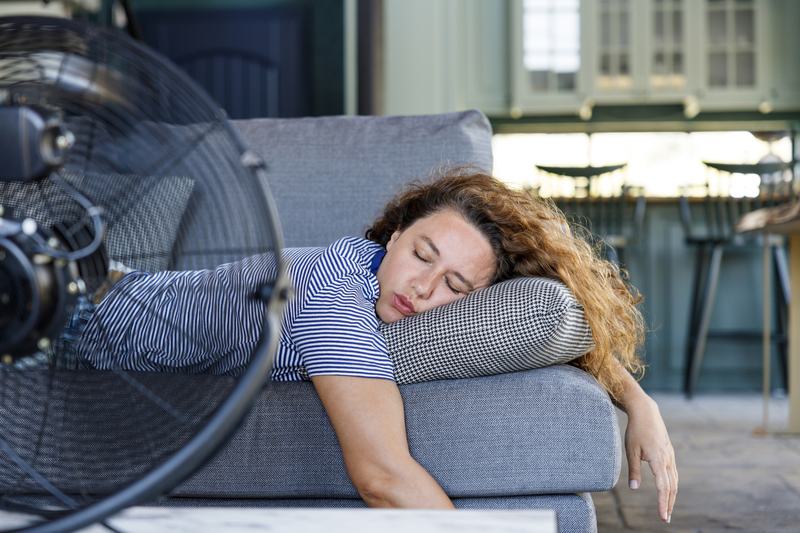
Dry air also makes breathing through your nose uncomfortable, especially at night. As nasal passages dry out, you are more likely to switch to mouth breathing.
This shift has consequences.
Mouth breathing bypasses the nose’s natural filtration and humidification. Over time, it can lead to dry mouth, sore throat, and poor sleep quality. You may wake up tired even when your sleep data looks fine. You might start snoring without realizing it, the only signs in the morning being a slightly sore throat and a dry mouth. Dentists also link chronic mouth breathing to a higher risk of tooth decay, bad breath, and gum issues.
Too much humidity creates problems too.
At higher relative humidity levels (above ~60%), sleep can become less stable. You may wake up more often and spend less time in both slow-wave NREM and REM sleep. Over time, less restorative sleep can affect recovery, concentration, and memory.
High humidity can also increase sweating and nighttime discomfort, further disrupting sleep.
And the effects of the 40–60% humidity rule go beyond sleep and recovery.
The Physics of Pathogens
Dry air does not only affect your airways. It also changes how long exhaled viral particles remain in the air around you.
If you’re working in an open office and the air is too dry, it is probably at least a little uncomfortable already. You’re probably keeping those eye drops close and a hand cream next to your computer. The face you see in the mirror before clocking out? Oddly dull and tired.
Those signs of low humidity are easy to notice. The viral particles circulating through the office because a colleague came in sick are not.
In dry air, those particles lose moisture and become lighter. Instead of settling down quickly, they can remain suspended in the air for much longer. Studies show that this is especially true for winter viruses.
That means you may spend hours breathing air where virus particles remain suspended for longer than they otherwise would. Over time, one colleague after another starts “catching the bug.”
Make the air too humid, and another set of risks kicks in.
Higher relative humidity allows mold, harmful bacteria, and dust mites to thrive. And when they thrive, you probably don’t.
Too humid spaces may start feeling heavier and more irritating to spend time in. You might wake up sneezing, congested, or with itchy eyes even when your sleep score, room temperature, and CO2 levels all seem perfectly normal.
This is why the 40–60% relative humidity rule matters.
It can help you reduce the airborne persistence of respiratory viruses, lower the infection risk, and support more restorative sleep and recovery. It can also prevent mold and dust mites from thriving, so you can breathe easily and feel comfortable while resting.
Beyond Health: Focus, Productivity, and Recovery
Humidity affects more than health and sleep.
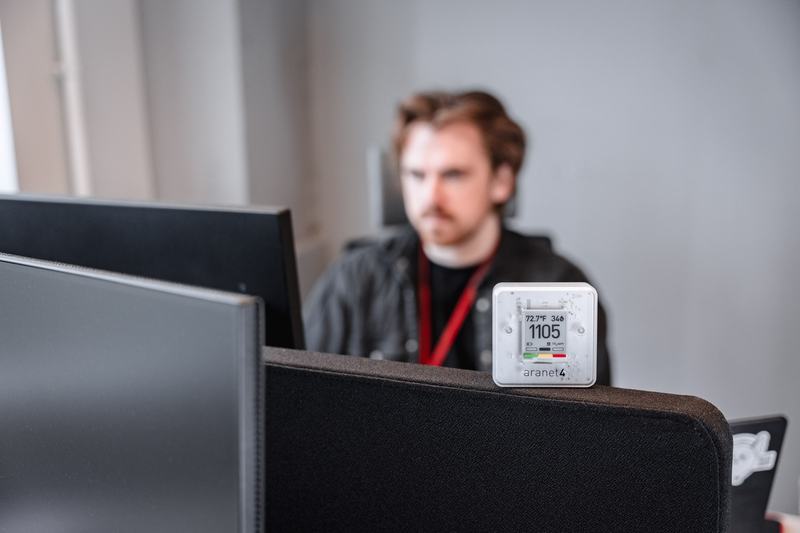
When the air is too humid, it becomes harder to stay sharp and productive. If you notice increased fatigue, sluggishness, and difficulty concentrating, humidity may be part of the problem. This can be especially noticeable in higher temperatures.
If your focus and work performance seem unusually inconsistent, stuffy air may be contributing more than you think.
Air too dry? Also not great.
By mid-afternoon, you may notice yourself rereading the same paragraph multiple times or struggling to stay focused on simple tasks. The same fatigue associated with overly humid air can also appear when humidity levels are too low.
Dry air tends to show up in subtle but familiar ways. Your lips crack more easily. Your eyes feel tired by the evening. Maybe you keep reaching for lip balm or wake up with a dry throat. Some people may even experience nosebleeds.
None of this creates an ideal environment for focus, recovery, or consistent cognitive performance.
The good news is that you can measure and adjust humidity.
Data-Driven Optimization with Aranet4 HOME
There are plenty of signs that signal the humidity levels aren’t optimal. However, that alone doesn’t really help you determine how they are off.
Fatigue can result from air that is too dry or too humid. The same goes for cold-like symptoms, poor sleep, difficulty staying focused, and waking up tired for no obvious reason.
That is why the numbers matter.
If you already track things like sleep, CO2, temperature, or recovery metrics, adding humidity into the mix can reveal patterns you might otherwise miss. The reasons behind your brain fog, poor recovery, or waking up tired may start making more sense.
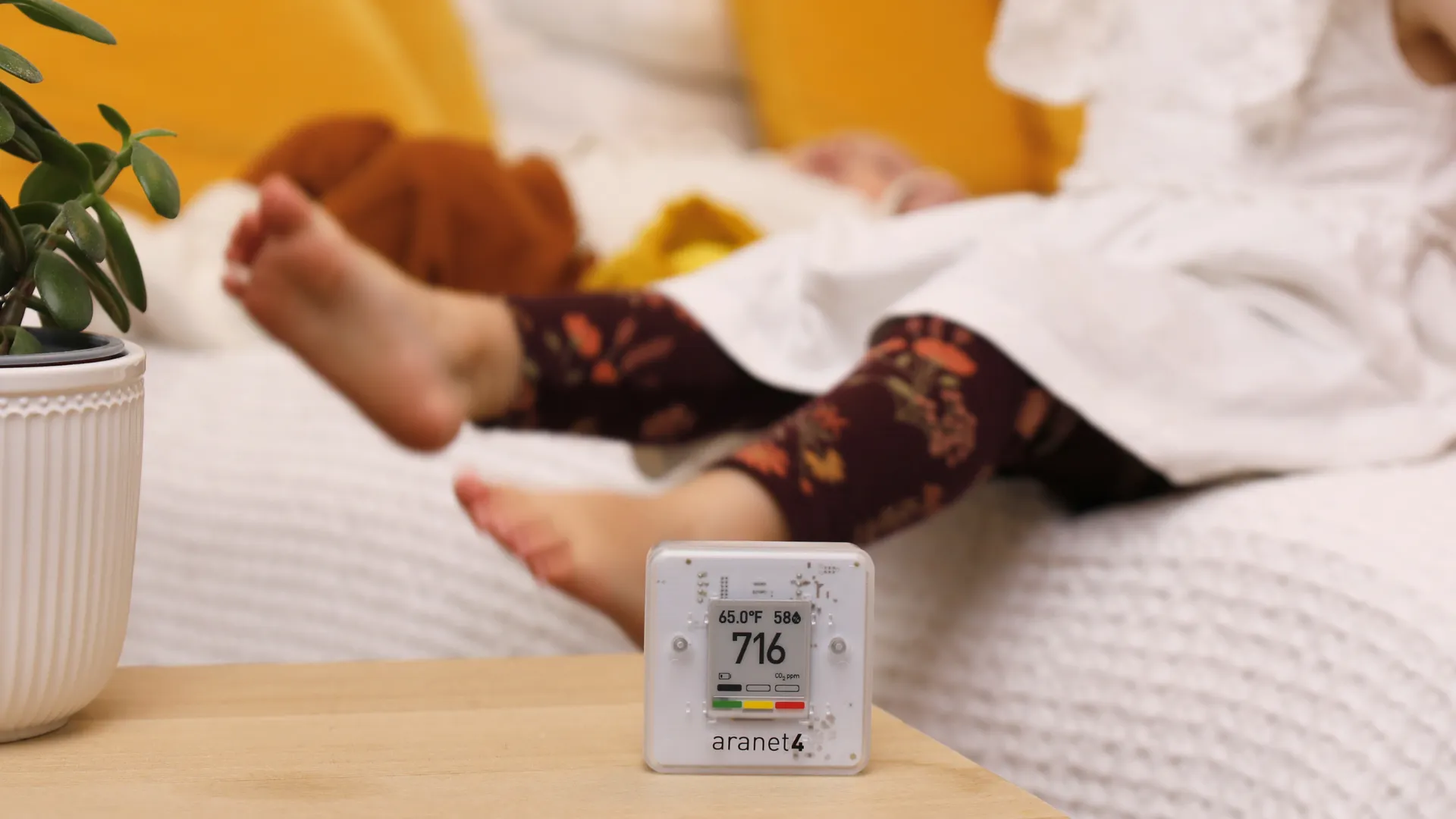
With an indoor air quality monitor like Aranet4 HOME or Aranet2, you can identify humidity problems before they turn into persistent discomfort, inconsistent recovery, or recurring respiratory irritation.
And because humidity does not exist in isolation, Aranet4 HOME uses high-precision sensors to track CO2, temperature, and humidity in real time. Together, these measurements create a clearer picture of the environment your body is actually recovering in every night.
That makes it easier to take practical action—opening a window, adjusting ventilation, or turning on a humidifier before poor indoor air quality starts affecting you.
Key Takeaways
If you regularly wake up congested, tired, irritated, or simply “off” despite optimizing your sleep environment, the explanation may not be as obvious as it seems.
Indoor air quality is not only about CO2 or ventilation. Humidity also plays a role in how well your body recovers, protects itself, and performs throughout the day.
For a high-performance indoor environment, humidity matters almost as much as CO2.
Too little humidity can weaken your airways’ natural defenses and disrupt sleep. Too much can make the air feel heavy and uncomfortable. The 40–60% rule is where the balance tends to work best for comfort, recovery, and health.
And because humidity problems do not always feel obvious right away, measuring them is key.
Know What's Really in Your Air
Humidity above or below the 40–60% range is easy to miss and easy to fix — if you can see it. Aranet4 Home tracks humidity, CO2, and temperature in real time, so you know exactly when it's time to open a window or turn on the humidifier.