United States (USA) (English / USD)

April 30, 2026
Can Houseplants Lower CO2 at Home?
Houseplants have a great reputation in indoor-air conversations, and it is easy to see why: they look fresh, feel healthy, and genuinely do absorb carbon dioxide during photosynthesis. But the gap between what plants can do in a controlled chamber and what they can do in a real living room is much larger than most people expect. In real homes, light levels, plant health, room size, occupancy, and ventilation matter so much that even a room full of greenery usually will not replace the simple impact of opening a window or improving air exchange. That does not make plants pointless, though. Research suggests they can still help raise indoor humidity, improve comfort, and make spaces feel better to live in, which is why the smartest message is not “plants versus ventilation” but “plants plus ventilation, with realistic expectations.”
What the evidence says about it?
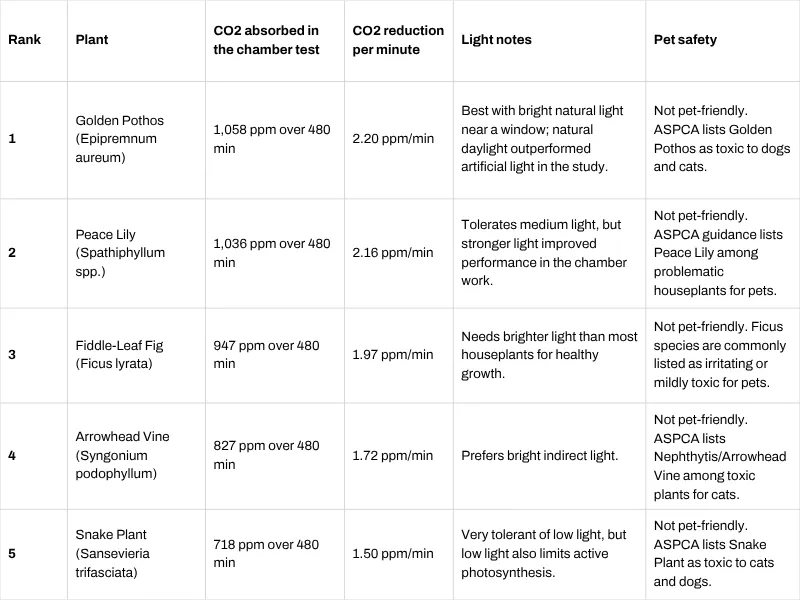
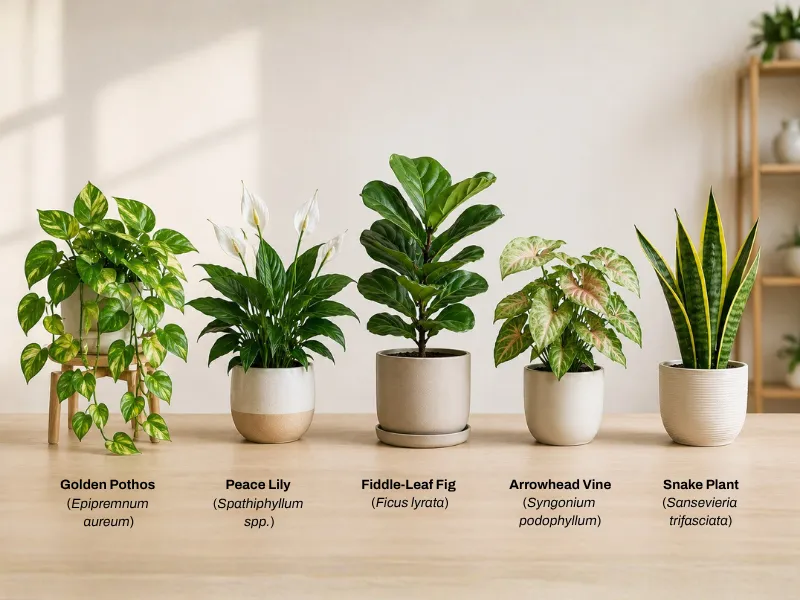
In a 2022 chamber study, six common ornamental plants were compared under controlled conditions starting at 2,000 ppm CO2, and the top performers were Golden Pothos (Epipremnum aureum) and Peace Lily (Spathiphyllum spp.). Under average natural daylight of 1,643 lux, six pots of Golden Pothos reduced cumulative chamber CO2 by 1,058 ppm over 480 minutes, while six pots of Peace Lily reduced it by 1,036 ppm over the same period. Ficus lyrata ranked third at 947 ppm, followed by Syngonium podophyllum at 827 ppm and Snake Plant (Sansevieria trifasciata) at 718 ppm.
Those numbers sound impressive, but the study used a tiny sealed chamber with a volume of just 0.192 m3 and a vertical green-wall setup under controlled lighting. That makes the results useful for comparing plant species, but not for assuming the same effect in a bedroom or living room with people entering, doors opening, and CO2 constantly being produced by occupants.
The best plants to choose
The pet-safe reality check
The strongest ornamental plants in this chamber study are not good choices for homes where pets chew leaves. If a home has curious cats or dogs, it is safer to prioritize non-toxic plants and accept that pet-safe options may not be the top CO2 performers in the available chamber data.
Spider Plant is often suggested as a safer compromise because it is commonly regarded as pet-friendly and easy to grow, but it was not among the top-performing species in the chamber ranking described above. In other words, the most CO2-active options and the most pet-safe options do not fully overlap.
How much plant would a room need?
This is the sad part: there is no realistic number of potted plants per square meter that can be recommended as a practical, proven way to significantly lower CO2 in a normal home. In a 2024 office study, adding 5 or even 18 Boston ferns to offices raised relative humidity substantially, but did not significantly change corrected CO2 concentration. Median humidity increased from 29.1 percent with no plants to 38.9 percent with 5 plants and 49.2 percent with 18 plants, while median corrected CO2 stayed broadly similar at 401.74 ppm with no plants, 398.03 ppm with 5 plants, and 397.40 ppm with 18 plants.
That does not mean plants do nothing; it means that in real occupied rooms, their CO2 effect is often overwhelmed by ventilation patterns, room size, light level, and the amount of CO2 people exhale. If the goal is significantly better indoor air, think of plants as a bonus feature, not the main control strategy.
Light matters more than you think
Another thing to note is that plants only remove CO2 efficiently when they are actively photosynthesizing, so light quality matters a lot. In the chamber study, natural daylight at an average of 1,643 lux outperformed artificial light, and 2,000 lux artificial light performed better than 1,000 lux. For Golden Pothos, CO2 absorbed under natural daylight was 1,058 ppm, compared with 467 ppm under 2,000 lux artificial light and 407 ppm under 1,000 lux artificial light.
For you, dear blog reader, the simple version is this: if a plant is struggling in a dark corner, it is not going to be an effective CO2 helper. Rooms with good daylight near windows are the best places for any plant-based air-quality strategy.
What plants are genuinely good for
Plants can still improve indoor spaces even when they are not a serious CO2 solution. In the 2024 office study, indoor plants clearly increased relative humidity, which matters because very dry indoor air can irritate the eyes, skin, and respiratory tract. The same study found median relative humidity rising into a more comfortable range when more plants were added, even though CO2 stayed largely unchanged.
That makes plants useful for comfort, perceived freshness, and wellbeing, especially in dry heating seasons. They are just not a substitute for fresh-air exchange when your monitor shows CO2 climbing.
Practical tips for lower CO2 at home
- Air out bedrooms in the morning, as sleeping people are a major overnight CO2 source in closed rooms.
- Create cross-ventilation by opening windows on opposite sides of the home when possible; moving fresh air beats passive plant absorption for CO2 control.
- Use kitchen and bathroom exhaust fans consistently, especially during cooking and showering, to support overall air exchange.
- Keep doors open between occupied rooms when privacy allows, as a larger connected air volume slows CO2 buildup.
- Avoid overcrowding small rooms for long periods; people are the main indoor CO2 source.
- Put your best-performing plants where they get bright natural light, as dark corners reduce photosynthetic activity and therefore CO2 uptake.
- If you have pets, skip toxic “top performers” and choose safer plants instead, then rely on ventilation rather than greenery for the real CO2 fix.
Why Aranet4 helps
The biggest problem with indoor CO2 is that it often feels invisible until the room already feels stuffy or people start noticing tiredness and reduced focus. A CO2 monitor such as Aranet4 helps turn that invisible buildup into a number you can act on, so you know when your plant-filled bedroom still needs a window opened. Plants can make a room nicer, greener, and in some cases more comfortable, but the smartest setup is plants plus measurement plus ventilation.