United States (USA) (English / USD)

June 11, 2026
Can a CO2 Monitor Help You Avoid Getting Sick Indoors? What Summer Air Is Really Telling You
Quick answer: No, a CO2 monitor can't spot a virus. What it can do is show you how much air you're sharing with the people around you, and shared air is how colds, flu and COVID get from one person to the next. When the CO2 reading climbs, you're breathing in more of everyone else's exhaled breath. That makes a single number a fast, practical stand-in for airborne illness risk in any room you step into.
Most people assume this is a winter problem. It isn't. COVID now runs on two peaks a year, a winter one and a summer one, and last summer cases were rising across more than two dozen US states by the middle of July. Europe usually sees its uptick a few weeks ahead of the US. So if you're reading this in June, the risk is already on the move.
The summer trap nobody talks about
Here's what changes when it gets hot. To escape the heat, everyone piles into the same air-conditioned spaces: shops, restaurants, offices, airport lounges. And most air conditioning doesn't bring in fresh outdoor air. It chills the air that's already inside and pushes it back around the room. The result feels lovely and cool, but it can be the same breath circulating for hours.

Then there's travel. Summer is peak season for planes, trains and packed terminals, and a recirculating cabin can send CO2 past 2,000 ppm within minutes of the doors closing. The air feels fine. Your monitor says otherwise.
This is the gap a CO2 reading fills. Outdoor air sits at roughly 420 ppm. Indoors, the only thing driving that number up is people breathing. A rising figure tells you, in real time, how much exhaled air is stacking up around you, and therefore how much of anything floating in it you're likely to inhale.
What the numbers actually mean
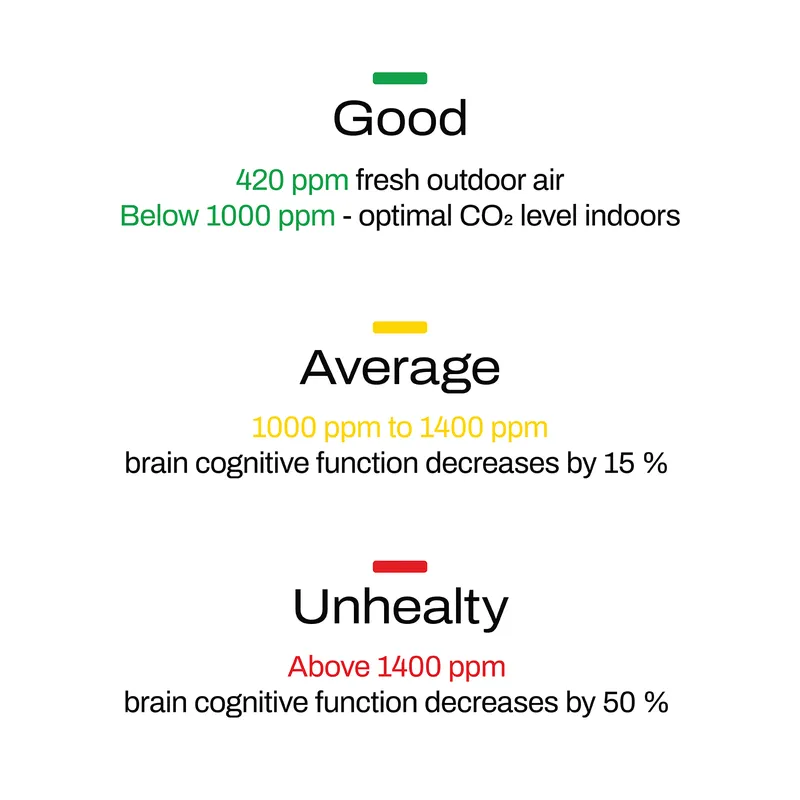
A few reference points worth keeping in your head:
- 400 to 1000 ppm. Fresh, well-ventilated air. Mostly your own breath and the outdoors. Ideally you should keep the number under 800 ppm.
- 1000 to 1,400 ppm. Getting stale. Ventilation is falling behind the number of bodies in the room.
- 1,400 ppm and up. Poor air exchange. A real chunk of what you're breathing has already passed through someone else's lungs, and your focus starts to slip too.
None of these is a hard line between safe and dangerous. Think of it as a dial. The lower you keep it, the more diluted any virus in the room becomes.
Where a reading earns its keep
The spaces worth watching are rarely your own living room.
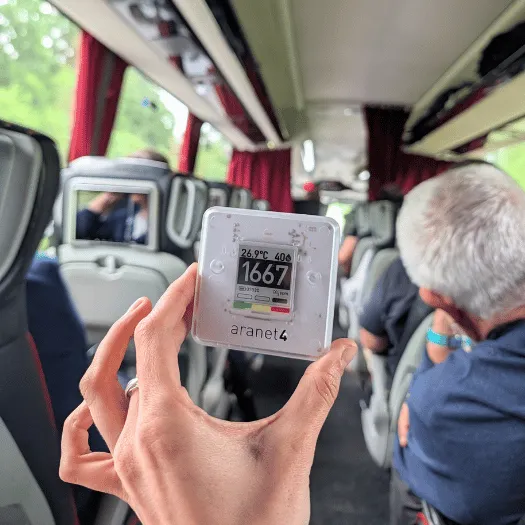
Cars and rideshares are an easy win. Switch the AC off recirculation and onto fresh-air intake, and you'll watch the number drop in under a minute. On a plane, a glance at the screen tells you whether to angle the overhead vent your way.
Indoor venues during a heatwave are the other one. A cinema, a busy café, a museum people have ducked into to cool off. Occupancy swings fast in summer and the ventilation often can't keep pace. The reading tells you whether to sit near a door or not bother sitting at all.
And it travels with you for the family stuff that fills a summer calendar: a grandparent's stuffy apartment, a crowded indoor party, a long coach ride. Anywhere a vulnerable person is breathing recycled air for a while, the monitor turns a guess into a fact.
The response is always low-drama and always the same. Number goes up, so you open a window, switch to fresh air, add a filter, put on a mask, or just move. You're acting on information, not on dread.
But won't measuring all this make me anxious?
It's a fair worry, and we hear it a lot. Our take is the other way round. Not knowing is what gnaws at you. A number on a screen swaps "is this room safe?" for a plain yes, no, or open a window. The honest reality is that most rooms read fine most of the time, and seeing that is a relief. On the rare occasion a space is genuinely badly ventilated, you find out in seconds rather than three days later when someone in the family comes down with something.
The other question we get is whether this is pointless if you already own an air purifier. A purifier scrubs particles in one corner of a room. It can't tell you whether the room as a whole is trading air with the outside. CO2 measures ventilation, which is the part a purifier leaves untouched. They handle different jobs, and the monitor is what tells you whether the purifier is actually keeping up.
The bottom line
A CO2 monitor is not a virus detector, and anyone selling it as one is overselling. What it gives you is the simplest reliable everyday signal for ventilation and shared-air exposure, summer or winter, at home or three rows back on a flight. For anyone looking after a vulnerable relative, or just hoping to get through travel season without catching whatever is going around the airport, that signal is hard to beat.
The air around you is already telling you whether it's safe to breathe. A monitor just lets you hear it.
See your air in real time
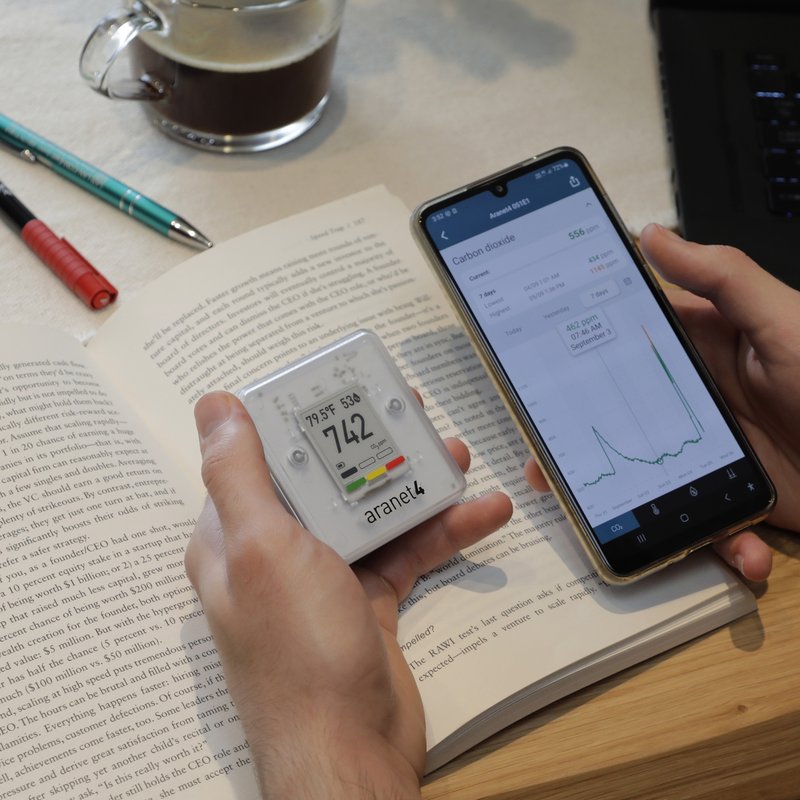
Aranet4 HOME reads CO2 with a true NDIR sensor, runs for years on regular batteries, and needs no subscription. Carry it from your kitchen to the airport and always know what you're breathing.