United States (USA) (English / USD)

June 07, 2026
Radon Detectors for 2026: Buyer's Guide With Independent Accuracy Data
Two of eight consumer radon monitors failed to meet the ±25% accuracy threshold at normal household concentrations in a 2024 Kansas State University radon chamber study. At higher concentrations, all eight performed acceptably. The takeaway: which device you choose matters less at dangerous levels and more at the ambiguous 2 to 4 pCi/L range where homeowners actually need reliable data to make mitigation decisions.
This guide evaluates 10 radon detectors across three categories: continuous home monitors, smart-connected monitors, and professional measurement instruments. Devices are grouped by monitoring approach rather than ranked in a single hierarchy, because a $140 battery-powered home monitor and a $9,500 professional instrument serve fundamentally different buyers.
Radon testing serves three primary scenarios. Continuous home monitoring tracks long-term trends and verifies mitigation performance. Professional measurement supports real estate transactions and compliance workflows. Baseline screening with passive test kits provides a one-time average for initial risk assessment. The right device depends on which problem you are solving.
No public health agency recognizes a safe level of radon exposure. The EPA recommends mitigation at 4 pCi/L (approximately 150 Bq/m³) and suggests considering action between 2 and 4 pCi/L. The WHO reference level is 100 Bq/m³ (approximately 2.7 pCi/L), and Health Canada sets its guideline at 200 Bq/m³ (approximately 5.4 pCi/L). A home that passes EPA's threshold may still exceed international guidance by a significant margin.
This guide is published by Aranet, and Aranet products are among the evaluated devices. The same evaluation criteria, accuracy verification standards, and limitation documentation apply to all devices, including our own. All specifications are verified against manufacturer datasheets and independent laboratory testing as of Q1 2026.
Radon Detector Comparison: 2026 Overview
The table below summarizes all devices evaluated in this guide. Detailed analysis, independent testing data, and individual device sections follow.
Accuracy figures reflect manufacturer-documented conditions, not marketing claims. Where independent C-NRPP laboratory data is available, it is included as a separate column. Pricing reflects publicly listed retail prices as of Q1 2026 and may vary by retailer.
Devices are grouped by category rather than ranked in a single numerical hierarchy. A continuous home monitor and a professional CRM serve different buyers, and a forced 1-through-10 ranking obscures that distinction.
Continuous Home Monitors

Smart Multi-Sensor Monitors

Professional and Screening Tools

How This List Was Created
This guide evaluates radon detectors based on documented technical criteria, not editorial opinion, star ratings, or affiliate commission structures.
Every device was assessed across six dimensions: sensor technology and detection method, stated accuracy under documented conditions, calibrated measurement range (not display range), time to reliable reading, connectivity and data access model, and independent validation where available.
The primary independent source is the C-NRPP 2024/25 Consumer-Grade Electronic Radon Monitor Performance Report, conducted at the Radiation Safety Institute of Canada's National Radon Chamber. This study exposed consumer devices to four controlled radon concentrations (218, 210, 436, and 1,201 Bq/m³) across varying temperature and humidity conditions over 7-day test rounds. It is the most rigorous publicly available accuracy comparison for consumer radon monitors.
Additional sources include the 2024 Kansas State University radon chamber evaluation (Bahadori and Hanson, published in the Journal of Radiological Protection), the 2025 longitudinal drift study examining two-year performance degradation in consumer devices, EPA and WHO regulatory guidance documents, Health Canada radon guidelines, and manufacturer datasheets and user manuals for each device.
Where a specification is not publicly documented by the manufacturer, it is labeled as "not published" or "not specified" rather than inferred or estimated. Where accuracy data comes from the manufacturer rather than independent testing, this is stated. Where a source has a commercial interest (including Aranet's own product documentation), that relationship is noted.
Devices are grouped by monitoring approach (continuous home monitors, smart multi-sensor monitors, professional instruments) rather than forced into a single numerical ranking. A battery-powered home monitor and a $9,500 research instrument do not compete for the same buyer, and pretending otherwise undermines the comparison.
How Radon Detectors Actually Work
Every radon detector measures the same thing: alpha particles released when radon-222 decays. The differences are in how each sensor captures those particles, how quickly it accumulates enough counts to produce a reliable average, and what trade-offs that detection method creates over months and years of operation.
Pulsed Ionization Chambers
Aranet Radon Plus, Aranet Radon One, Ecosense RadonEye RD200, EcoQube, EcoQube Flex, and EcoBlu all use variations of this approach. Radon gas diffuses into a sealed chamber held under a DC electric field. When a radon atom or its daughter products undergo alpha decay, the 5.49 MeV alpha particle ionizes gas molecules along its path, creating roughly 100,000 ion pairs. The electric field sweeps these ions to collection electrodes, producing a measurable current pulse. Each pulse represents one decay event.
Sensitivity depends on chamber volume and field geometry. The RadonEye RD200 achieves 30 counts per hour per pCi/L from a 200 cc chamber, making it the most sensitive consumer device available. Aranet Radon Plus uses a 137 cm³ chamber. Higher sensitivity means faster statistical convergence, which is why pulsed ionization devices can deliver a reliable 1-hour average while passive diffusion sensors need 24 hours or more.
The main limitation is long-term progeny buildup. As radon decays inside the chamber, solid daughter products (particularly lead-210, with a 22.3-year half-life) gradually accumulate on interior surfaces. This creates a small background signal that increases over years of exposure. Aranet addresses this by publishing expected drift rates and incorporating a progeny effect compensation algorithm that adjusts readings based on the time-evolution of pulse rates. In practical terms, the drift is small enough for residential use over the device's battery lifetime, but it is a real physical constraint that every ionization-based detector shares.
One additional characteristic: pulsed ionization chambers cannot distinguish radon-222 from thoron (radon-220) because both produce alpha particles in similar energy ranges. In most residential environments, thoron concentrations are negligible. In structures built with certain stone or soil conditions, thoron interference can produce slightly elevated readings.
Passive Diffusion Alpha Spectrometry
Airthings devices (View Plus, View Radon, Corentium Home 2) use this method. Radon diffuses through a filtered membrane into a small detection chamber containing a silicon photodiode. When alpha particles strike the photodiode, they produce electrical signals proportional to the particle's energy, allowing partial spectral discrimination.
The photodiode intercepts only a fraction of decays occurring in the chamber, so count rates are significantly lower than in pulsed ionization devices. This is why Airthings specifies 24 hours to a first reading and recommends 30 days for stable long-term accuracy (±5% at 2 months versus ±10% at 7 days, both at a 200 Bq/m³ reference concentration).
The trade-off favors longevity. Without an active electric field and with no significant progeny accumulation on the photodiode, passive diffusion sensors avoid the long-term drift issue. However, humidity affects the diffusion membrane. The C-NRPP 2024/25 testing documented this directly: the Airthings Corentium Home dropped from an A grade to a B grade in the 70% relative humidity test round.
Electrostatic Collection with Spectral Analysis
The DURRIDGE RAD7 represents a fundamentally different class of instrument. It applies a 2,000 to 2,500 V electrostatic field inside a 0.7-liter hemispherical chamber, driving positively charged polonium-218 daughters onto a passivated implanted planar silicon (PIPS) detector. The full alpha energy spectrum is recorded, allowing the RAD7 to distinguish radon-222 decay products (6.00 MeV from Po-218, 7.69 MeV from Po-214) from thoron decay products (6.78 MeV from Po-216, 8.78 MeV from Po-212).
This spectral discrimination is unique among devices in this guide and is the reason the RAD7 remains the reference standard for professional radon diagnostics. The practical constraint is humidity: water vapor clusters neutralize the positively charged polonium ions before they reach the detector, so the RAD7 requires a desiccant drying column in its air intake loop. Combined with its $9,500 price point and annual calibration requirement ($686), this is an instrument for professionals and researchers, not homeowners.
Why This Matters for Choosing a Device
Sensor technology determines three things that directly affect your experience: how quickly you get a reliable reading (1 hour for ionization chambers versus 24+ hours for passive diffusion), how humidity affects accuracy (documented for passive diffusion, minimal for ionization chambers within operating range), and what happens to accuracy over years of continuous operation (gradual drift for ionization chambers, stable but slower for passive diffusion). Marketing language rarely surfaces these trade-offs. The comparison table and device sections that follow are organized around them.
Independent Accuracy Data: What Laboratory Testing Actually Shows
Manufacturer accuracy claims are tested under each company's own conditions, at reference concentrations they choose, over averaging windows they define. Independent laboratory testing removes those variables and places every device in the same chamber, at the same concentrations, for the same duration. Two studies provide the most useful data for consumers in 2026.
C-NRPP 2024/25 Consumer-Grade Performance Report
The Canadian National Radon Proficiency Program published its most recent consumer device evaluation in mid-2025, conducted at the Radiation Safety Institute of Canada's National Radon Chamber. Six consumer monitors were tested across four 7-day rounds at progressively higher radon concentrations, with one round introducing elevated humidity (70% RH at 210 Bq/m³).
Each device received letter grades per round: A (within 10% of reference value), B (10 to 20% error), and C (20 to 30% error).

Several patterns matter for buyers.
The EcoQube and Lüft were the only devices to receive A grades in every round. Both are AC-powered, Wi-Fi-connected monitors with pulsed ionization sensors. Their consistent performance across all concentrations and humidity conditions is the strongest independent result in this dataset.
The Aranet Radon Plus and RadonEye RD200 both received B grades only at the highest concentration (1,201 Bq/m³, roughly 32 pCi/L). This is well above the EPA action level and represents an environment where professional measurement would typically be recommended regardless of consumer monitor readings. At the concentrations where homeowner decisions are actually made (200 to 500 Bq/m³, or roughly 5 to 13 pCi/L), both devices scored A in every round.
The Airthings Corentium Home received a B grade in the elevated humidity round. This is consistent with the known humidity sensitivity of passive diffusion sensors and is relevant for placement in basements or other high-moisture environments.
The Airthings View received a C grade at 436 Bq/m³ (roughly 12 pCi/L), the concentration closest to the EPA action level multiplied by a safety margin. This is the range where accurate readings most directly influence mitigation decisions. The View performed well at lower and higher concentrations, suggesting the issue may be specific to the sensor's behavior at mid-range levels rather than a systematic accuracy problem.
Kansas State University 2024 Chamber Study
A separate evaluation by Bahadori and Hanson at Kansas State University, published in the Journal of Radiological Protection, tested eight consumer monitors at 0.6, approximately 14, and approximately 28 pCi/L against ANSI/AARST MS-PC 2022 standards. Device names were not published.
The headline finding: two of eight devices failed to meet the ±25% Individual Percent Error requirement at 0.6 pCi/L, which is close to the average outdoor radon concentration and representative of low-radon homes. At higher concentrations, all eight devices performed within acceptable limits.
The practical takeaway is important. At low concentrations (below roughly 2 pCi/L), the physics of radioactive counting statistics mean that short-term readings from any consumer device will show significant variability. This is not a defect. It is a mathematical consequence of counting rare events. Long-term averages (7 days or more) reduce this uncertainty substantially.
Long-Term Drift: What Happens After Two Years
A 2025 longitudinal study published in ScienceDirect (S2950362026000184) examined performance degradation in consumer radon monitors over a two-year period. The finding that matters: the Airthings Wave Plus and Ecosense EcoQube drifted below acceptable accuracy thresholds after two years, while the Ecosense RadonEye RD200 maintained its calibration.
This result is worth pausing on. The EcoQube and RadonEye use the same underlying pulsed ionization technology with identical 30 cph/pCi/L sensitivity ratings. Yet their two-year drift trajectories diverged. Sensor technology category alone does not predict long-term reliability. Implementation quality, chamber design, and internal compensation algorithms all contribute.
No equivalent published drift data exists for the Aranet Radon Plus, which launched more recently. Aranet has provided drift estimates to independent reviewers (BreatheSafeAir documented this), but no peer-reviewed longitudinal study has been published. This is a gap worth acknowledging rather than ignoring.
What to Consider Before Choosing a Radon Detector
The previous sections explained detection physics and independent accuracy data. This section maps those factors to practical buying decisions.
Averaging Windows and What Your Reading Actually Means
Radon detectors do not measure radon concentration the way a thermometer measures temperature. They count random decay events and calculate a statistical average over time. Fewer counts mean wider uncertainty. More counts mean tighter confidence.
This is why every accuracy specification in this guide includes a time condition. The Aranet Radon Plus states ±8% accuracy, but that figure applies to 24-hour, 7-day, and 30-day averages, not to a single 10-minute reading. The Airthings View Plus states ±5% accuracy, but only after two months of continuous measurement at a 200 Bq/m³ reference concentration.
A reading that jumps from 2.1 to 5.8 pCi/L overnight does not necessarily mean your radon level tripled. At low concentrations, hourly readings from any consumer device can swing by 50 to 100% due to counting statistics alone. The 7-day average is the minimum window health agencies reference for decision-making. The 30-day and longer averages are what matter for assessing annual exposure risk.
Calibrated Range vs. Display Range
Several devices in this guide can display radon values beyond their stated calibration range. The Aranet Radon Plus is calibrated to 4,000 Bq/m³ (108 pCi/L) but displays readings up to 7,900 Bq/m³. Airthings devices display up to 20,000 Bq/m³ but specify accuracy at a 200 Bq/m³ reference concentration.
Readings outside the calibrated range are not meaningless, but they carry no documented accuracy guarantee. For most homes, this distinction is academic: the EPA action level is 148 Bq/m³ (4 pCi/L), well within every device's calibrated range. It becomes relevant in high-radon environments, uranium-bearing geology, or post-disaster monitoring scenarios where concentrations can exceed 1,000 Bq/m³.
Connectivity: What You Gain and What You Give Up
The connectivity choice is not about better or worse. It is about which constraints you accept.
Bluetooth-only devices (Aranet Radon Plus, Aranet Radon One, RadonEye RD200, Corentium Home 2, EcoQube Flex) require physical proximity (typically within 10 meters) to sync data with a phone app. You cannot check readings remotely. In exchange, there is no cloud dependency, no Wi-Fi configuration, no account creation, and no risk that a server shutdown disables your device.
Wi-Fi devices (Airthings View Plus, Airthings View Radon, Ecosense EcoQube, SunRADON Lüft) sync continuously to cloud dashboards and can send alerts when levels rise. You can monitor a vacation home or basement from anywhere. The trade-off: you depend on the manufacturer's cloud service remaining operational, and setup requires a 2.4 GHz Wi-Fi network (5 GHz is not supported by any device in this guide).
Local-display-only devices (Ecosense EcoBlu, SafetySiren Pro Series) show readings on the device and store nothing externally. No app, no sync, no historical export. Simple, but you lose trend analysis and data logging.
For most homeowners monitoring a single location where they physically live, Bluetooth is sufficient. Wi-Fi becomes important for remote properties, multi-location monitoring, or users who want automated alerts without manual syncing.
Consumer Monitors and Real Estate Transactions
No consumer radon detector in this guide is accepted for real estate transaction testing under ANSI/AARST MAH protocols. This includes every Aranet, Airthings consumer, Ecosense consumer, and SunRADON Lüft device.
Real estate testing requires a device with annual third-party calibration certificates, tamper detection capability, and hourly data logging per AARST standards. Acceptable instruments include the SunRADON XP+, Ecosense RadonEye Pro (RD200P), Ecosense EcoQube Pro, Airthings Corentium Pro, and the DURRIDGE RAD7. These are professional tools, not consumer purchases.
If you are buying or selling a home, hire a certified radon measurement professional through NRPP (nrpp.info) or your state radon program. A consumer monitor provides valuable ongoing awareness but does not replace professional testing for transactions.
Best Radon Detectors 2026
Aranet Radon Plus: Best Overall Continuous Home Monitor
Category: Continuous home monitor. Price: $189 (frequently $170 on sale). Sensor: Pulsed ionization chamber, 137 cm³. Accuracy: ±8% at 24h/7d/30d. C-NRPP: A/A/A/B. Connectivity: Bluetooth only. Power: 2× AA, marketed at 4.5 to 7 years. Display: E-ink with color-coded status. Manufactured in Latvia by SAF Tehnika.
The Aranet Radon Plus uses a 137 cm³ pulsed ionization chamber with a progeny effect compensation algorithm that adjusts for the time lag between radon entering the chamber and its daughter products reaching decay equilibrium. In practical terms, this means a reliable 1-hour average rather than requiring the 24+ hours that passive diffusion sensors need. The device measures radon alongside temperature, relative humidity, and atmospheric pressure, which provides context for interpreting radon fluctuations (barometric pressure drops correlate with indoor radon increases due to reduced soil-gas differential).
In the C-NRPP 2024/25 laboratory evaluation, the Radon Plus received A grades in three of four test rounds, including the 436 Bq/m³ round (approximately 12 pCi/L) where the Airthings View received a C. Its B grade came at 1,201 Bq/m³ (approximately 32 pCi/L), a concentration where professional measurement is typically recommended regardless of consumer monitor readings. Among pulsed ionization devices in the C-NRPP evaluation, only the Ecosense EcoQube outperformed it with straight-A grades across all four rounds.
The stated ±8% accuracy (under defined averaging conditions) is the tightest published specification among consumer devices in this guide. The next closest is RadonEye's <±10%. However, manufacturer-stated accuracy and independent lab performance are different measures, and the C-NRPP data shows the Radon Plus is not the top performer across all conditions.
Strengths
The Radon Plus offers the fastest path to a reliable reading among battery-powered devices in this guide: 10 minutes to first display, 1 hour to a usable average. The e-ink display is always visible without pressing buttons or opening an app, and the color-coded background (green, yellow, red) provides instant status from across a room. Dual-unit support (pCi/L and Bq/m³) covers both North American and international users. The Aranet Home app requires no account creation, no cloud subscription, and no recurring fees. Bluetooth syncing is straightforward, and the device is natively supported in Home Assistant for smart home integration. At $189 retail ($170 on sale), the 5-year total cost of ownership is approximately $190 with no additional expenses for batteries, subscriptions, or calibration over the device's operational lifetime.
Limitations
Bluetooth-only connectivity means you must be within approximately 10 meters to sync data with the app. There is no Wi-Fi, no cloud dashboard, and no remote monitoring capability. If you place the device in a basement and want to check readings from upstairs or from work, you cannot do so without physically walking to the device or within Bluetooth range. The Airthings View Plus and Ecosense EcoQube both offer Wi-Fi with remote access.
There is no native integration with Alexa, Google Assistant, or IFTTT. The Home Assistant support is community-maintained, not officially developed by Aranet. For users invested in voice-assistant ecosystems, the Airthings View Plus is the only device in this guide with native support for all three platforms.
The Aranet Home app, while clean and subscription-free, does not display rolling average history as effectively as the Airthings app, which provides more granular trend visualization and data export options. BreatheSafeAir noted this in their hands-on review.
The battery latch on the device body has been described by independent reviewers as feeling less robust than expected for a device designed for multi-year deployment. This does not affect measurement performance but is a build-quality observation worth noting.
Battery life is marketed at up to 7 years offline and 4.5 years with Bluetooth enabled. Independent calculations based on power consumption specifications suggest real-world figures closer to 5 years offline and 3.3 years with Bluetooth. The marketing numbers represent maximum theoretical life under optimal conditions.
No peer-reviewed longitudinal drift study has been published for the Aranet Radon Plus. Aranet has shared drift estimates privately with reviewers, and the expected drift is described as manageable for residential use, but this has not been independently verified over multi-year periods in the way that RadonEye RD200 data has been published.
The Radon Plus was not the top performer in C-NRPP testing. The Ecosense EcoQube received straight-A grades across all four rounds, including the high-concentration round where the Radon Plus received a B.
How Aranet Radon Plus fits the landscape
The Radon Plus is not the most accurate device in independent testing (EcoQube holds that position), not the most connected (View Plus), not the fastest to respond (RadonEye's 30 cph/pCi/L sensitivity exceeds it), and not the cheapest (Aranet Radon One and EcoBlu undercut it). What it offers is a combination that no single competitor matches: battery-powered portability with the fastest reliable reading among portable devices, documented ±8% accuracy with transparent averaging conditions, multi-sensor environmental data (temperature, humidity, pressure) for interpreting radon behavior, zero recurring costs over a multi-year deployment, and a privacy-respecting app model with no accounts, no cloud dependency, and no subscription.
For a homeowner placing a single device in a basement for continuous long-term monitoring, the Radon Plus delivers the strongest overall balance of measurement reliability, operational simplicity, and total cost. At approximately $190 over five years with no additional expenses, it costs roughly $125 less than the Airthings View Plus over the same period and $10 less than the View Radon, while providing a faster path to reliable readings and tighter stated accuracy.
The trade-off is connectivity. If remote monitoring, cloud dashboards, or smart home voice control are requirements rather than nice-to-haves, the Airthings View Plus or Ecosense EcoQube serve those needs better. If budget is the primary constraint, the Aranet Radon One delivers the same sensor platform at $140 with slightly wider accuracy tolerance.
Aranet Radon One: Best Budget Continuous Monitor
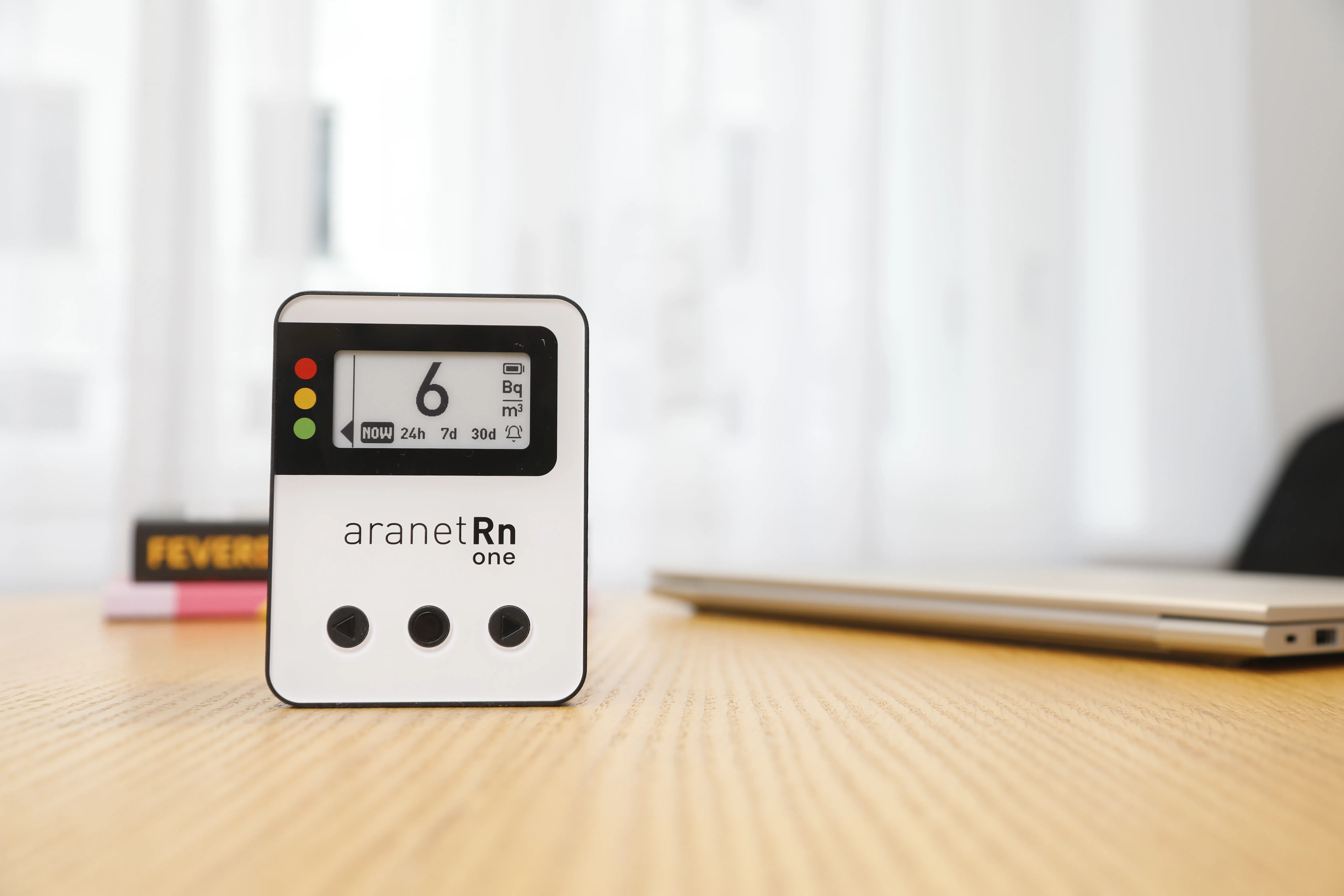
Category: Continuous home monitor. Price: $140 (frequently $120 on sale). Sensor: Pulsed ionization chamber, 152 cm³, with progeny compensation. Accuracy: ±10% at 24h/7d/30d. C-NRPP: Not yet tested. Connectivity: Bluetooth only. Power: 2× AA, marketed at 4.5 to 7 years. Display: E-ink with 3 navigation buttons. Manufactured in Latvia by SAF Tehnika.
The Radon One is Aranet's entry-level continuous monitor, launched in December 2025 as a radon-only alternative to the multi-sensor Radon Plus. It uses the same pulsed ionization detection method and the same progeny effect compensation algorithm, but strips away the temperature, humidity, and pressure sensors to reduce cost.
The accuracy trade-off is straightforward. The Radon One is rated at ±10% under the same 24-hour, 7-day, and 30-day averaging conditions where the Radon Plus achieves ±8%. That 2-percentage-point difference is meaningful in absolute terms but modest in practice: at the EPA action level of 4 pCi/L, ±8% means a true range of 3.68 to 4.32, while ±10% means 3.60 to 4.40. Both are well within the uncertainty that already exists from natural radon fluctuation, placement variation, and diurnal cycling.
The chamber is actually larger than the Radon Plus (152 cm³ vs. 137 cm³), but BreatheSafeAir's review notes that the detection efficiency is lower, which accounts for the wider accuracy tolerance despite the greater volume. The practical result is the same: 10 minutes to a first displayed reading, approximately 1 hour to a reliable average.
The device has not been included in C-NRPP laboratory testing as of Q1 2026, having launched after the 2024/25 evaluation period. This is a genuine gap. The Radon Plus has independent validation; the Radon One currently relies on manufacturer specifications only. For buyers who weight independent testing data heavily, this matters.
What you lose compared to the Radon Plus, beyond the 2% accuracy difference, is environmental context. Without temperature, humidity, and pressure readings, you cannot correlate radon spikes with barometric drops or seasonal humidity changes on the same device. You still see radon trends, but the interpretive layer is thinner. The e-ink display adds three navigation buttons that let you cycle through current, 24-hour, 7-day, and 30-day averages directly on the device without opening the app.
What you keep is everything that defines the Aranet platform: pulsed ionization with progeny compensation, fast 1-hour averaging, e-ink always-on display, Bluetooth with the same no-account Aranet Home app, multi-year battery life from 2 AA cells, dual pCi/L and Bq/m³ units, and zero recurring costs.
How Aranet Radon One fits the landscape
At $140, the Radon One competes directly with the Ecosense EcoBlu ($129 to $169) and sits below the Airthings Corentium Home 2 ($179), the Ecosense RadonEye RD200 ($170 to $199), and the Aranet Radon Plus ($189). Among these, it is the only battery-powered device with a 1-hour path to reliable readings. The Corentium Home 2 needs 24 hours. The RadonEye and EcoBlu require AC power.
For a homeowner who wants continuous monitoring without plugging into a wall outlet, does not need Wi-Fi or remote access, and prefers the lowest cost of entry with no ongoing expenses, the Radon One is the most direct option in 2026. The $50 savings over the Radon Plus comes at the cost of ±10% vs. ±8% accuracy, no environmental sensors, and no independent C-NRPP validation. Whether that trade-off is acceptable depends on whether you are monitoring for general awareness (Radon One is sufficient) or verifying mitigation performance where tighter accuracy margins matter (Radon Plus is the stronger choice).
Airthings Corentium Home 2: Best Portable Monitor With App Ecosystem
Category: Continuous home monitor. Price: $179. Sensor: Passive diffusion alpha spectrometry (patented, originally developed 2011). Accuracy: ±10% at 4 days (370 Bq/m³ reference). C-NRPP: A/B/A/A (original Corentium Home, same sensor platform). Connectivity: Bluetooth 4.2, Wi-Fi available via optional Airthings Hub. Power: 2× AA, approximately 3 years. Display: LCD. Designed in Norway.
The Corentium Home 2 replaced the original Corentium Home in mid-2025 and is Airthings' dedicated radon-only portable monitor. It uses the same passive diffusion sensor that Airthings has refined since 2011, making it one of the longest-running consumer radon detection platforms on the market. The sensor design is proven, but the underlying physics of passive diffusion mean it requires significantly longer to reach a reliable reading than pulsed ionization devices.
Where the Corentium Home 2 holds a genuine advantage over every Aranet device is the app ecosystem. The Airthings app provides detailed trend visualization with daily, weekly, and monthly graphs, straightforward data export, multi-device management for households running more than one Airthings sensor, and an optional cloud dashboard when paired with an Airthings Hub or SmartLink-enabled device. For users already invested in the Airthings platform (View Plus for air quality, Wave for other rooms), the Corentium Home 2 integrates into a unified monitoring environment that Aranet's standalone Bluetooth model cannot replicate.
The trade-off is time to first reliable reading. Airthings specifies ±10% accuracy at 4 days, improving to roughly ±5% after 60 days, both referenced at 370 Bq/m³. Pulsed ionization devices (Aranet, RadonEye, EcoQube) achieve comparable accuracy windows in 1 to 24 hours. If you need to assess a room quickly, whether after moving the device, checking a new floor level, or verifying a mitigation system just activated, the Corentium Home 2 is the slowest consumer device in this guide to deliver a confident number.
The C-NRPP 2024/25 evaluation tested the original Corentium Home (same sensor platform) and assigned it A grades in three rounds, with a B in the elevated humidity round (70% RH at 210 Bq/m³). This is a known characteristic of passive diffusion sensors: moisture on or near the diffusion membrane affects the rate at which radon enters the detection chamber. For basement placement in climates with seasonal humidity above 65%, this is worth factoring into expectations. Pulsed ionization devices in the same C-NRPP evaluation did not show humidity-dependent performance degradation.
The Corentium Home 2 introduces Bluetooth 4.2 (the original had no wireless connectivity at all) and extends the display range to 250 pCi/L. Battery life is rated at approximately 3 years from 2 AA cells, shorter than the Aranet devices' 4.5 to 7 year claims but still a multi-year deployment without maintenance.
At $179, the Corentium Home 2 sits between the Aranet Radon One ($140) and the Aranet Radon Plus ($189). It costs $39 more than the Radon One and $10 less than the Radon Plus. The 5-year total cost of ownership is approximately $190, comparable to the Radon Plus, once a battery replacement is factored in.
For buyers who prioritize the Airthings app experience, plan to add other Airthings sensors over time, or want the option of Wi-Fi connectivity through a hub, the Corentium Home 2 is the logical choice in its price range. For buyers who prioritize speed to reliable reading, humidity tolerance, or the tightest available accuracy specification, the pulsed ionization alternatives in this guide outperform it on those specific dimensions.
Ecosense RadonEye RD200: Best Fast-Response Real-Time Monitor
Category: Continuous home monitor. Price: $170 to $199. Sensor: Dual-channel pulsed ionization chamber, 200 cc, 30 counts per hour per pCi/L. Accuracy: <±10% at 10 pCi/L reference. C-NRPP: A/A/A/B. Connectivity: Bluetooth only. Power: AC plug-in (no battery option). Display: 0.96-inch OLED. Manufactured by FTLab, South Korea.
The RadonEye RD200 has the highest documented sensitivity of any consumer radon monitor: 30 counts per hour per pCi/L from a 200 cc dual-channel ionization chamber. In practical terms, this means it accumulates counting statistics faster than any other device in this guide, producing the tightest short-term confidence intervals. If you need to observe how radon responds to opening a window, adjusting HVAC settings, or activating a mitigation fan, the RadonEye shows the effect in near real-time where other devices would still be averaging out the noise.
This responsiveness is validated by the 2025 longitudinal drift study, which found that the RadonEye RD200 maintained its calibration accuracy over a two-year period. The same study found that the Ecosense EcoQube and the Airthings Wave Plus both drifted below acceptable thresholds over the same timeframe. Given that the RadonEye and EcoQube share the same 30 cph/pCi/L pulsed ionization platform from the same manufacturer, this divergence points to implementation differences (chamber geometry, firmware compensation, quality control) rather than sensor technology category. For a device you plan to run for years without recalibration, the RadonEye has the only published evidence of long-term stability among consumer monitors.
In the C-NRPP 2024/25 evaluation, the RadonEye received A grades in three rounds and a B at 1,201 Bq/m³, matching the Aranet Radon Plus exactly. At the concentrations where homeowners make decisions (200 to 500 Bq/m³), both devices performed identically in independent testing.
The limitations are practical rather than measurement-related. The RadonEye requires a wall outlet. There is no battery option, which means no portability between rooms without unplugging and restarting the averaging cycle. The 0.96-inch OLED display is readable up close but not across a room the way the Aranet's e-ink display is. There is no on-device historical view; all trend data requires the Bluetooth app.
The app itself is a known pain point. The RadonEye app has been consistently criticized on Reddit's r/radon community for being clunky, unreliable on some phone models, and region-locked in certain territories outside North America. BreatheSafeAir excluded the RadonEye from their primary recommendation list partly because of app reliability concerns, even while acknowledging the hardware's measurement quality. A community-maintained Home Assistant integration (jdeath/rd200v2 on GitHub) exists as a workaround for users who want automated data logging without depending on the official app, but this requires technical setup that most homeowners will not attempt.
There is no Wi-Fi connectivity, no cloud dashboard, no Alexa or Google integration, and no IFTTT support. The RadonEye is a measurement-first device with minimal user experience polish. It reads radon extremely well. Everything else around that core function is utilitarian at best.
At $170 to $199, it costs roughly the same as the Aranet Radon Plus ($189) and the Airthings Corentium Home 2 ($179). The 5-year total cost is approximately $170 to $200 (AC power, no battery replacements, no subscriptions). The choice between the RadonEye and the Aranet Radon Plus comes down to whether you value portability and display readability (Aranet) or maximum measurement sensitivity and proven long-term stability (RadonEye). Both performed identically in C-NRPP testing at decision-relevant concentrations.
Ecosense EcoQube: Best Wi-Fi Connected Monitor
Category: Continuous home monitor. Price: $179 to $229. Sensor: Pulsed ionization chamber, 30 counts per hour per pCi/L. Accuracy: >90% after 10 hours. C-NRPP: A/A/A/A. Connectivity: Wi-Fi 2.4 GHz only. Power: AC plug-in. Display: 3-color LED status indicator (no numeric screen). Manufactured by FTLab, South Korea.
The EcoQube is the only consumer radon monitor to receive straight-A grades across all four rounds of the C-NRPP 2024/25 laboratory evaluation, matching the SunRADON Lüft and outperforming every other device tested, including the Aranet Radon Plus. At 218 Bq/m³, 210 Bq/m³ with 70% humidity, 436 Bq/m³, and 1,201 Bq/m³, the EcoQube stayed within 10% of the reference value every time. That is the strongest independent accuracy record in this guide.
It is also the only consumer device in the sub-$250 range with Wi-Fi connectivity and IFTTT integration. The EcoQube syncs to Ecosense's cloud platform over a 2.4 GHz network, providing remote access to readings, trend charts, and a free 72-hour "My Radon Analysis" diagnostic report. You can check your basement radon level from your office, receive alerts when readings spike, and trigger IFTTT automations (such as activating a ventilation fan) based on radon thresholds. No Aranet device and no Airthings device under $229 offers this combination.
The limitations are equally specific. The EcoQube has no numeric display on the device itself. It shows a three-color LED (green, yellow, red) for general status, but if you want to see an actual pCi/L number, you must open the app. For homeowners who want a glanceable reading from across the room, the Aranet Radon Plus, Airthings Corentium Home 2, and Ecosense's own RadonEye all provide on-device numeric displays.
It requires AC power with no battery option, eliminating portability. You choose a location, plug it in, and it stays there. Moving it means restarting the averaging cycle.
The app has the same regional availability concerns as the RadonEye. BreatheSafeAir excluded the EcoQube from their primary recommendation list partly because the app's full functionality is inconsistent outside North America. For US and Canadian buyers this is not an issue, but international users should verify app availability in their region before purchasing.
The most significant caveat is long-term reliability. Despite its perfect C-NRPP lab performance, the 2025 longitudinal drift study found that the EcoQube drifted below acceptable accuracy thresholds after two years of continuous operation. The RadonEye RD200, using the same 30 cph/pCi/L sensor platform from the same manufacturer, did not show comparable drift. This is a finding that deserves weight. A device can test perfectly in a 7-day lab round and still degrade over the multi-year deployment period that continuous home monitoring requires.
Ecosense has not published a response to the drift study or documentation of any firmware or hardware revision addressing the finding. Whether current production units have improved long-term stability is not publicly documented. This guide notes the finding transparently rather than ignoring it or treating it as definitive.
At $179 to $229, the EcoQube is priced comparably to the Aranet Radon Plus ($189) and above the RadonEye RD200 ($170 to $199). The 5-year total cost is approximately $200 (AC powered, no subscriptions, no calibration). For buyers who need Wi-Fi remote access, cloud dashboards, and IFTTT automation, the EcoQube is the lowest-cost option that delivers all three. For buyers who prioritize on-device readability, battery portability, or documented long-term stability, other devices in this guide serve those needs better.
Airthings View Plus: Best Multi-Sensor Smart Home Monitor
Category: Smart multi-sensor monitor. Price: $299. Sensor: Passive diffusion alpha spectrometry + PM2.5, CO2, VOC, temperature, humidity, pressure (7 sensors total). Accuracy: ±10% at 7 days, ±5% at 2 months (200 Bq/m³ reference). C-NRPP: A/A/C/A. Connectivity: Wi-Fi 2.4 GHz + Bluetooth + SmartLink. Power: 6× AA, approximately 2 years. Display: 2.9-inch e-paper. Designed in Norway.
The View Plus is the only device in this guide with native Alexa, Google Assistant, and IFTTT integration. It is also the only consumer monitor that measures radon alongside six other air quality parameters, making it a complete indoor environment dashboard rather than a single-purpose radon detector. For a household that wants one device covering radon, particulate matter, CO2, and volatile organic compounds with remote access and voice queries, nothing else in this guide competes.
The radon measurement trade-off is real. The View Plus uses the same passive diffusion sensor family as other Airthings devices, meaning 24 hours to a first reading and 30 to 60 days for the tightest accuracy. In the C-NRPP 2024/25 evaluation, it received a C grade at 436 Bq/m³ (approximately 12 pCi/L), the concentration range closest to the EPA action level with a safety margin. It scored A in the other three rounds, including the high-humidity test where the Corentium Home dropped to B.
The C grade deserves context rather than dismissal. The View Plus packs seven sensors into a battery-powered housing, which constrains the physical space available for the radon diffusion chamber. A smaller chamber means fewer counts per interval, which means wider statistical variance at mid-range concentrations. This is a design trade-off inherent to multi-sensor devices, not a manufacturing defect.
At $299 with a 5-year total cost of approximately $315, it is the most expensive consumer device in this guide. The premium buys breadth of measurement and the strongest smart home integration available. It does not buy the tightest radon accuracy. Buyers whose primary concern is radon precision rather than multi-parameter monitoring will get better radon-specific performance from any Tier 1 device in this guide at $60 to $130 less.
Ecosense EcoQube Flex: Best New Battery-Powered Alternative
Category: Continuous home monitor. Price: approximately $199 to $249 (retail pricing not formally published as of Q1 2026). Sensor: Pulsed ionization chamber, 30 counts per hour per pCi/L. Accuracy: >95% after 10 hours. C-NRPP: Not yet tested. Connectivity: Bluetooth only. Power: 2× AA, manufacturer claims 2 to 7 years. Display: E-ink, always-on. 2026 Edison Award nominee. Manufactured by FTLab, South Korea.
The EcoQube Flex, launched December 15, 2025, is Ecosense's first battery-powered radon monitor with an always-on display. It addresses the two most common criticisms of the original EcoQube: AC-only power and the absence of an on-device numeric screen. The e-ink display and AA battery operation place it in direct competition with the Aranet Radon Plus and Aranet Radon One.
The sensor platform is the same 30 cph/pCi/L pulsed ionization chamber used in the EcoQube and RadonEye, which means comparable measurement sensitivity. Ecosense states >95% accuracy after 10 hours, a tighter claim than the original EcoQube's >90%. Whether this reflects a hardware improvement or a different specification methodology is not publicly documented.
The significant gap is independent validation. The EcoQube Flex launched after the C-NRPP 2024/25 testing period and has not appeared in any published independent evaluation. The original EcoQube received all-A grades in C-NRPP testing, but the 2025 drift study raised questions about long-term stability for that platform. Whether the Flex inherits the EcoQube's lab accuracy, its drift characteristics, both, or neither is currently unknown.
Bluetooth-only connectivity is a step down from the original EcoQube's Wi-Fi. Buyers who valued the EcoQube for remote access and IFTTT automation will not find those features here. The Flex trades connectivity for portability.
At an estimated $199 to $249, the EcoQube Flex is priced above the Aranet Radon One ($140) and overlaps with the Aranet Radon Plus ($189) and original EcoQube ($179 to $229). For buyers drawn to the Ecosense platform who want battery portability and an on-device display, the Flex is the first option that delivers both. For buyers who want independently validated accuracy, the Aranet Radon Plus and the original EcoQube both have C-NRPP data behind them; the Flex does not, yet.
SunRADON Lüft: Best Plug-In Consumer Alternative With Independent Validation
Category: Continuous home monitor. Price: $230 to $280. Sensor: Solid-state silicon diffusion. Accuracy: approximately 90% (validated by C-NRPP). C-NRPP: A/A/A/A. Connectivity: Wi-Fi 2.4 GHz + Bluetooth setup. Power: AC plug-in. Display: Color LED status indicator (no numeric screen). Manufactured in the USA.
The Lüft shares one distinction with the Ecosense EcoQube: it is the only other consumer device to receive straight-A grades across all four C-NRPP 2024/25 test rounds. Where the EcoQube uses a pulsed ionization chamber, the Lüft uses a solid-state silicon diffusion sensor, making it the only device in this guide to achieve top-tier independent accuracy with that detection method.
It also offers Wi-Fi connectivity with cloud access at a price point ($230 to $280) between the EcoQube ($179 to $229) and the Airthings View Plus ($299). For buyers who want Wi-Fi remote monitoring backed by the strongest available independent validation, the Lüft and EcoQube are the two options. The Lüft costs more but uses a fundamentally different sensor technology, providing diversification if you are cross-checking with a second device.
The limitations mirror the EcoQube's usability gaps. There is no numeric screen on the device, only color LED status indication. All readings require the app. It is AC-powered with no battery option. BreatheSafeAir noted consistently negative durability reviews for the Lüft, with multiple reports of units failing within months of purchase. This reliability concern is not reflected in the C-NRPP lab data (which tests new or recently calibrated units over 7-day windows) and could represent a batch quality issue rather than a design flaw, but it appears frequently enough in user reports to warrant mention.
At $230 to $280, the Lüft is the most expensive single-purpose consumer radon monitor in this guide. The 5-year total cost is approximately $250, below the Airthings View Plus ($315) but above every other consumer device. For buyers who prioritize C-NRPP-validated accuracy with Wi-Fi connectivity and are comfortable with LED-only status display, the Lüft delivers that combination. For buyers concerned about long-term hardware reliability or who need an on-device numeric readout, other devices in this guide have stronger track records or better display options.
SunRADON XP+: Professional Continuous Radon Monitor
Category: Professional CRM. Price: Quote only (not publicly listed). Sensor: Patented solid-state diffusion, NRPP/NRSB/C-NRPP certified. Connectivity: Bluetooth + USB-C, optional LTE. Power: 4× AA, approximately 300 hours per test cycle. Display: Color touchscreen.
The XP+ exists in a different category from every consumer device in this guide. It is designed for certified radon measurement professionals conducting real estate transaction testing, post-mitigation verification, and regulatory compliance work. It carries NRPP and NRSB device certification, meaning its calibration, tamper detection, and data logging meet the requirements of ANSI/AARST MAH protocols.
SunRADON bundles the XP+ with OneRADON software (first year included), which manages test deployment, client reporting, and calibration scheduling. Annual calibration is required to maintain certification, an operational cost that does not apply to consumer devices.
No consumer monitor in this guide, regardless of measurement quality, substitutes for a certified CRM in professional workflows. If you are a home inspector, mitigation contractor, or real estate professional, the XP+ and its competitors (Ecosense RadonEye Pro, Ecosense EcoQube Pro, Airthings Corentium Pro) are the correct product category. If you are a homeowner, this device is not designed for you.
DURRIDGE RAD7: Professional Research Instrument
Category: Professional research instrument. Price: $9,400 to $9,500. Sensor: Electrostatic collection with PIPS silicon alpha spectrometry. Accuracy: ±5% absolute, ±2% reproducibility. Calibrated range: 0.1 to 10,000 pCi/L. Connectivity: RS-232/USB, optional Bluetooth. Power: Rechargeable internal + 12V external. Display: LCD + optional thermal printer. Manufactured in Billerica, Massachusetts, USA.
The RAD7 is included in this guide not as a purchase recommendation for homeowners but as the accuracy reference point against which all consumer devices can be contextualized. Its ±5% absolute accuracy and ±2% reproducibility represent the ceiling of commercially available radon measurement. It is the only device in this guide that distinguishes radon-222 from thoron (radon-220) through full alpha energy spectral analysis.
The operational requirements reflect its professional purpose. It needs a Drierite desiccant column to maintain electrostatic collection efficiency, annual calibration at $686 per session, and optional Capture Pro software at $1,200 for advanced spectral analysis. The 5-year total cost of ownership approaches $14,000. It weighs approximately 4.5 kg and is not a device you place on a basement shelf and forget.
Researchers, environmental consultants, and radon professionals use the RAD7 for scenarios that no consumer monitor addresses: soil gas measurement, water radon analysis, thoron discrimination, and multi-point diagnostic surveys. For homeowners, its relevance is indirect: when this guide states that the Aranet Radon Plus or RadonEye RD200 perform within 10% of reference values in C-NRPP testing, the reference instruments establishing those values operate at RAD7-class precision.
A Note on Unvalidated Budget Devices
The C-NRPP 2024/25 evaluation did not just identify strong performers. It also flagged multiple consumer radon monitors that failed testing or were recalled during the evaluation period. Devices from INKBIRD, LifeBasis, Boyd Gresham, Funny Kitchen, Hanchen, Radon Guard, Spolehli, and Bootu (model RN-80) were either recalled or performed outside acceptable accuracy thresholds.
These devices share common characteristics: pricing typically under $80, undisclosed sensor technology, no published accuracy specifications with defined conditions, no independent laboratory validation, and no manufacturer-accessible calibration pathway. They are widely available on Amazon, often with high star ratings driven by volume rather than measurement verification.
A radon monitor that reads 1.5 pCi/L when the true concentration is 5.2 pCi/L does not just provide a wrong number. It provides false confidence that prevents a homeowner from taking action on a genuine health risk. For a device whose entire purpose is informing decisions about a Class A carcinogen, validated accuracy is not a premium feature. It is the minimum requirement.
If you encounter a consumer radon detector priced below $80 from a brand not represented in the C-NRPP evaluation or this guide, verify whether the manufacturer publishes accuracy specifications with defined conditions and reference concentrations. If they do not, the device cannot be meaningfully evaluated, and spending an additional $60 to $100 on a validated monitor is a defensible investment.
Short-Term and Long-Term Passive Radon Test Kits
This guide focuses on continuous electronic monitors, but passive test kits remain a valid option for specific scenarios.
Short-term charcoal test kits ($15 to $35) measure radon over 2 to 7 days and require mail-in laboratory analysis. They provide a single snapshot average, not ongoing monitoring. They are accepted for real estate transaction screening when deployed in pairs per ANSI/AARST protocols, and they are the lowest-cost path to a first radon reading for a homeowner who has never tested.
Long-term alpha track test kits ($25 to $40) measure cumulative exposure over 90 days to one year and also require laboratory analysis. Because they average across seasonal fluctuations, their results align more closely with annual exposure estimates, which is the timeframe health agencies reference when assessing risk. For a homeowner who wants a baseline annual measurement without purchasing a continuous monitor, alpha track kits remain the recognized approach.
Neither kit type provides real-time readings, trend visibility, or the ability to verify mitigation performance. If you need any of those capabilities, a continuous monitor is the correct product category.
Understanding Your Readings: What Normal Radon Behavior Looks Like
A continuous monitor will show you patterns that a one-time test kit never reveals. Knowing which patterns are normal prevents unnecessary alarm and helps you recognize when action is genuinely warranted.
Why Readings Spike at Night
Indoor radon follows a predictable diurnal cycle. Concentrations typically peak between midnight and early morning, then drop through the afternoon. The driver is the stack effect: warm indoor air rises and exits through upper-level gaps, creating negative pressure at ground level that draws soil gas (including radon) into the basement. At night, the temperature differential between heated indoor air and cold outdoor air is greatest, ventilation is minimal (windows closed, HVAC often idle), and the atmospheric inversion layer traps ground-level air. By mid-afternoon, natural ventilation and reduced temperature differential allow concentrations to fall. Swings of 2 to 5 times between the daily low and high are common under normal conditions.
Why Winter Readings Are Higher Than Summer
The same stack effect operates seasonally. CDC Environmental Public Health Tracking data across 46 states over 13 years shows monthly mean indoor radon of approximately 204 Bq/m³ in January versus approximately 130 Bq/m³ in July, a 57% seasonal difference. In high-radon zones, the swing can be more extreme. A Minnesota home testing 2 pCi/L in July and 30 pCi/L in January is not experiencing a malfunction. It is experiencing physics. This is why year-round continuous monitoring provides a fundamentally different risk picture than a single short-term test performed in summer.
What Mitigation Looks Like on a Continuous Monitor
If a sub-slab depressurization system is installed, a continuous monitor will typically show a visible downward trend within 1 to 4 hours of activation. Readings generally stabilize at the new reduced level within 24 to 48 hours. EPA and NRPP protocols require post-mitigation testing no sooner than 24 hours and no later than 30 days after system activation. A continuous monitor is the most practical way to verify that a mitigation system is performing as expected over time, which is one of the strongest arguments for owning one rather than relying on periodic test kits.
Why Two Monitors Show Different Numbers
Placing two consumer monitors side by side will almost always produce different readings, and the discrepancy will be widest at low concentrations. This is not a defect. At 2 pCi/L, a device counting 15 events per hour has a statistical uncertainty of roughly ±18% per hourly bin (the square root of 15, divided by 15). Two devices independently sampling the same air will land at different points within that uncertainty band. At 10 pCi/L, the same device counts approximately 75 events per hour and the per-hour uncertainty drops to roughly ±12%. Airthings publishes guidance specifically addressing this: their help center recommends comparing 7-day or longer averages rather than hourly readings when cross-checking devices. The 7-day average is where counting statistics converge and meaningful comparison becomes possible.
Common Radon Detector Buying Mistakes
Most radon testing errors come from misunderstanding how measurement works, not from choosing the wrong brand. These are the mistakes that show up most frequently in user forums, professional discussions, and the data reviewed for this guide.
Trusting "EPA Approved" Marketing
EPA does not approve, certify, or endorse specific radon detectors. The agency's radon proficiency program ended in 1998. Devices marketed as "EPA approved" or "EPA evaluated" are referencing a defunct program that has not operated for over 25 years. The SafetySiren Pro Series, for example, has historically used "EPA evaluated" language based on its participation in the original program. Current professional device certification is managed by NRPP and NRSB, and no consumer monitor in this guide appears on either list.
Buying Unvalidated Sub-$80 Devices
The C-NRPP 2024/25 evaluation recalled or flagged devices from eight brands for failing accuracy thresholds. All were priced under $80. A device that reads 1.5 pCi/L when the true concentration is 5.2 pCi/L creates a health risk through false confidence. The Devices to Avoid section of this guide lists the specific brands identified by C-NRPP.
Comparing Hourly Readings Between Devices
Two monitors placed side by side will show different hourly numbers, especially below 4 pCi/L. This is counting statistics, not device failure. At 2 pCi/L, a typical consumer device has roughly ±18% statistical uncertainty per hourly reading. Compare 7-day averages, not hourly snapshots. Airthings publishes specific guidance on this in their help center.
Ignoring Averaging Windows in Accuracy Claims
The Aranet Radon Plus states ±8% accuracy, but that applies to 24-hour, 7-day, and 30-day averages. The Airthings View Plus states ±5%, but only after two months at a 200 Bq/m³ reference. Treating these as directly comparable without reading the conditions behind each number leads to misleading conclusions about relative performance. The C-NRPP evaluation in this guide provides the closest available apples-to-apples comparison.
Using a Consumer Monitor for Real Estate Transactions
No consumer device in this guide meets ANSI/AARST MAH protocol requirements for real estate testing. Those protocols require annual third-party calibration certificates, tamper detection, and hourly data logging. A homeowner who provides an Aranet or Airthings reading to a buyer's agent during a transaction is providing data that no inspector, lender, or certification body will accept. Professional CRMs (SunRADON XP+, RadonEye Pro, EcoQube Pro, Corentium Pro) exist for this purpose.
Testing Only in Summer
CDC tracking data across 46 states shows indoor radon averaging 57% higher in January than in July. A short-term test conducted in August may produce a reading below the EPA action level that would be well above it in December. If you can only test once, test in winter. If you own a continuous monitor, the seasonal data will show you the difference directly.
Assuming Calibrated Range Equals Display Range
The Aranet Radon Plus is calibrated to 4,000 Bq/m³ but displays up to 7,900 Bq/m³. Airthings devices display up to 20,000 Bq/m³ but specify accuracy at a 200 Bq/m³ reference. Readings above the documented calibration range carry no stated accuracy guarantee. For most homes this is irrelevant (the EPA action level is 148 Bq/m³), but in high-radon environments it matters.
How to Choose the Right Radon Detector in 2026
The comparison table and vendor sections provide the data. This section maps that data to five common buyer scenarios.
You want long-term home monitoring without recurring costs
The Aranet Radon Plus ($189) delivers the strongest combination of documented accuracy (±8%), fast 1-hour reliable readings, battery portability, and zero ongoing expenses. The Aranet Radon One ($140) provides the same sensor platform at a lower price with slightly wider accuracy tolerance (±10%) and no environmental sensors. Both require Bluetooth proximity for app access. If you have never tested your home for radon and want a device you can place in a basement and trust for years, either Aranet device is the most direct path.
You need Wi-Fi remote access and smart alerts
The Ecosense EcoQube ($179 to $229) is the lowest-cost option with Wi-Fi, cloud dashboards, and IFTTT automation, backed by the strongest C-NRPP accuracy record (A/A/A/A). The trade-off is AC-only power and no on-device numeric display. The Airthings View Plus ($299) adds native Alexa, Google Assistant, and IFTTT alongside six additional air quality sensors, but at a higher price and with a C grade at the most decision-relevant C-NRPP concentration. The SunRADON Lüft ($230 to $280) offers Wi-Fi with matching all-A C-NRPP performance but has documented durability concerns in user reports.
You want the fastest real-time feedback
The Ecosense RadonEye RD200 ($170 to $199) has the highest sensitivity of any consumer device at 30 counts per hour per pCi/L and the only published evidence of long-term calibration stability over two years. It requires AC power, has no Wi-Fi, and the app has known usability and regional availability limitations.
You are buying or selling a home
No consumer device in this guide qualifies for real estate transaction testing. Hire a certified radon measurement professional through NRPP (nrpp.info) or your state radon program. Professional CRMs (SunRADON XP+, RadonEye Pro, EcoQube Pro, Corentium Pro) meet ANSI/AARST MAH protocol requirements for calibration, tamper detection, and hourly logging.
You want a low-cost first screening
A short-term charcoal test kit ($15 to $35) provides an initial snapshot within a week. Deploy two kits side by side per ANSI/AARST guidance for the most reliable result. If levels come back above 2 pCi/L, follow up with a continuous monitor for long-term tracking.
Five-Year Total Cost of Ownership
Purchase price does not capture the full cost of continuous monitoring. Battery replacements, subscription fees (where applicable), and calibration requirements all affect long-term value. No consumer device in this guide requires a subscription. The table below reflects total documented costs over a five-year ownership period.

Battery costs assume manufacturer-estimated replacement intervals and standard AA/AAA pricing. The Aranet Radon Plus and Radon One claim 4.5 to 7 years from a single set of AA batteries; independent estimates suggest closer to 3.3 to 5 years with Bluetooth enabled, which may require one replacement within a 5-year window. The table reflects the manufacturer claim of zero replacements. If one replacement is needed, add approximately $3 to $5.
The RAD7 is included for reference only. Its $686 annual calibration and $1,200 software license are professional operational costs, not consumer expenses.
Radon Detector FAQ
How often should I replace a consumer radon monitor?
No manufacturer in this guide publishes a recommended replacement interval. The Aranet Radon Plus battery is marketed for up to 7 years, suggesting an intended device lifespan of at least that long. However, the 2025 longitudinal drift study found that the Ecosense EcoQube and Airthings Wave Plus drifted below acceptable accuracy after two years, while the RadonEye RD200 held calibration. Without a user-accessible recalibration option on any consumer device, the practical answer is to cross-check your monitor against a second device or a short-term test kit every 2 to 3 years to verify it is still reading within a reasonable range.
Do radon levels differ between floors of a house?
Yes, substantially. Radon enters from soil contact, so the lowest level typically has the highest concentration. A basement reading of 6 pCi/L might correspond to 2 to 3 pCi/L on the first floor and under 1 pCi/L on the second floor, though this varies with building construction, HVAC airflow patterns, and how well floors are sealed. EPA guidance recommends testing on the lowest lived-in level. If you use an upper floor bedroom as your primary living space but have an unoccupied basement, test both levels to understand the full picture.
Can radon be in my drinking water?
Yes. Groundwater can dissolve radon from surrounding rock, and it releases into indoor air when you run taps, showers, or appliances. EPA estimates that water containing 10,000 pCi/L contributes roughly 1 pCi/L to indoor air. This is primarily a concern for homes on private wells rather than municipal water systems, which typically aerate water sufficiently to release dissolved radon before distribution. The devices in this guide measure airborne radon only. Water radon testing requires a separate mail-in water test kit, available from laboratories like SimpleLab for approximately $150 to $200.
What does radon mitigation cost if my levels are high?
The most common residential mitigation method is sub-slab depressurization (SSD), which installs a PVC pipe and fan system to draw radon from beneath the foundation and vent it above the roofline. Typical installation costs range from $800 to $2,500 depending on home size, foundation type, and local contractor rates. Operating costs are approximately $50 to $150 per year in electricity for the fan. A continuous monitor is valuable post-mitigation because it verifies ongoing system performance without requiring repeated professional tests.
Are free radon test kits available?
Many state radon programs offer free or discounted short-term test kits to residents. The American Lung Association coordinates distribution in several states. The National Radon Program Services at Kansas State University (sosradon.org) maintains a directory of state-level programs and offers discounted kits directly. These are charcoal-based short-term kits, not continuous monitors, but they provide a valid initial screening at no cost.
Does the unit of measurement (pCi/L vs. Bq/m³) affect which device I should buy?
All consumer devices in this guide except the Ecosense EcoBlu support both pCi/L (used in the United States) and Bq/m³ (used internationally). The conversion factor is 1 pCi/L = 37 Bq/m³. The EPA action level of 4 pCi/L equals approximately 148 Bq/m³. The WHO reference level of 100 Bq/m³ equals approximately 2.7 pCi/L. If you are comparing your readings to international guidelines, verify that your device is set to the correct unit. Aranet, Airthings, and RadonEye devices allow unit switching in their settings or app.
Should I worry about radon from granite countertops?
Granite can contain trace uranium and emit small amounts of radon, but peer-reviewed research consistently shows that the contribution to indoor radon from countertops is negligible compared to soil gas entry. EPA has stated that granite countertops are not a significant source of residential radon exposure. If your continuous monitor shows elevated readings, the source is almost certainly the foundation-soil interface, not your kitchen surfaces.
References
U.S. Environmental Protection Agency. "A Citizen's Guide to Radon: The Guide to Protecting Yourself and Your Family from Radon." EPA 402/K-12/002. Establishes the 4 pCi/L action level and 2 to 4 pCi/L consideration range referenced throughout this guide.
U.S. Environmental Protection Agency. "EPA Map of Radon Zones." Originally published 1993. Defines Zone 1 (predicted average >4 pCi/L), Zone 2 (2 to 4 pCi/L), and Zone 3 (<2 pCi/L) classifications. EPA cautions against using the map for individual home decisions; home-level testing is always recommended.
U.S. EPA Office of Inspector General. Report 09-P-0151 (2009). "EPA Does Not Provide Oversight of Radon Testing Device Accuracy or Reliability." Confirms that EPA does not certify, approve, or endorse specific radon devices. Cited in Common Mistakes and methodology sections.
World Health Organization. "WHO Handbook on Indoor Radon: A Public Health Perspective." 2009. Establishes the 100 Bq/m³ reference level (approximately 2.7 pCi/L) cited in the introduction and comparison framework.
Health Canada. "Guide for Radon Measurements in Residential Dwellings." Current edition. Sets the Canadian guideline at 200 Bq/m³ (approximately 5.4 pCi/L) with mitigation timelines based on concentration ranges.
ANSI/AARST MAH-2019. "Protocol for Conducting Measurements of Radon and Radon Decay Products in Homes." Defines real estate transaction testing requirements including calibration, tamper detection, and hourly logging standards referenced in the real estate and common mistakes sections.
ANSI/AARST MS-PC 2022. "Protocol for Conducting Measurements of Radon and Radon Decay Products in Schools and Large Buildings." Referenced in the Kansas State University study methodology.
C-NRPP 2024/25 Consumer-Grade Electronic Radon Monitor Performance Report. Radiation Safety Institute of Canada, National Radon Chamber. Published June 2025. Tested six consumer devices across four 7-day rounds at 218, 210 (70% RH), 436, and 1,201 Bq/m³. Source for all C-NRPP grades cited in this guide. Independent, non-commercially funded evaluation.
C-NRPP October 2023 Consumer-Grade ERM Report. Earlier evaluation round providing longitudinal comparison data for devices tested in both cycles. Referenced for historical context.
Bahadori, A. and Hanson, D. (2024). "Evaluation of consumer digital radon measurement devices: a comparative analysis." Journal of Radiological Protection. doi:10.1088/1361-6498/ad4bf1. Kansas State University radon chamber study testing eight unnamed consumer monitors at 0.6, approximately 14, and approximately 28 pCi/L. Source for the low-concentration accuracy finding cited in the introduction.
"Two-year performance drift in real-time and low-grade radon devices: A longitudinal study." 2025. Published in ScienceDirect (S2950362026000184). Documented accuracy degradation in the Ecosense EcoQube and Airthings Wave Plus over 24 months, with the Ecosense RadonEye RD200 maintaining calibration. Cited in the independent accuracy, EcoQube, and RadonEye sections.
Hernandez, T.L. et al. (1993). "Wind and Barometric Pressure Effects on Radon in Two Mitigated Houses." Documents the relationship between barometric pressure drops and indoor radon increases, including 10x concentration spikes during pressure events. Referenced in the Understanding Your Readings section.
Mahat, R.H. et al. (2001). "The effect of humidity on the accuracy of measurement of an electret radon dosimeter." Published in Radiation Physics and Chemistry. Documented approximately +0.5 Bq/m³ per percent RH effect on electret chambers. Referenced for context on humidity sensitivity across detection methods.
Kamgang, E. et al. CDC Environmental Public Health Tracking Program. 13-year dataset across 46 states documenting seasonal indoor radon variation. Source for the 204 Bq/m³ January versus 130 Bq/m³ July seasonal figures cited in Understanding Your Readings and Common Mistakes sections.
Fournier, F. et al. (2012). "The iSERIES radon progeny compensation algorithm and its application to air filters." U.S. Department of Energy, OSTI #1055933. Describes the kinetic correction approach conceptually related to Aranet's progeny effect compensation algorithm. Referenced for technical context in the sensor physics section.
Schubert, M. and Paschke, A. (2015). "Correcting for H2O interference using a RAD7 electrostatic collection-based silicon detector." Published in Journal of Environmental Radioactivity. Documents the mechanism by which humidity degrades electrostatic radon collection. Referenced in the RAD7 section.
Aranet (SAF Tehnika). Radon Plus datasheet, product code TDSPSRH2, version 1.12 (October 2024). Primary source for Aranet Radon Plus specifications including ±8% accuracy, 0 to 4,000 Bq/m³ calibrated range, 7,900 Bq/m³ display range, and 137 cm³ chamber volume. Commercially interested source.
Aranet (SAF Tehnika). Radon One product page and Amazon listing. Specifications for ±10% accuracy, 0 to 4,000 Bq/m³ range, and December 2025 launch date. Full datasheet PDF not independently located in public indexing as of Q1 2026. Commercially interested source.
Airthings. View Plus product sheet (March 2024). Source for 7-sensor configuration, ±10% at 7 days / ±5% at 2 months accuracy specification at 200 Bq/m³ reference, and Wi-Fi/SmartLink connectivity. Commercially interested source.
Airthings. View Radon product sheet. Source for sensor specifications and pricing. Commercially interested source.
Airthings. Corentium Home 2 product page. Source for ±10% at 4 days (370 Bq/m³ reference), Bluetooth 4.2, and 250 pCi/L display range. Commercially interested source.
Airthings Help Center. "How to compare low radon levels between two or more monitors." Guidance on comparing 7-day averages rather than hourly readings. Referenced in Understanding Your Readings and Common Mistakes sections.
Ecosense / FTLab. RadonEye RD200 user manual and product page. Source for 200 cc chamber volume, 30 cph/pCi/L sensitivity, and <±10% accuracy at 10 pCi/L. Commercially interested source.
Ecosense. EcoQube product page and Amazon listing. Source for 30 cph/pCi/L sensitivity, >90% accuracy after 10 hours, Wi-Fi 2.4 GHz specification, and IFTTT support. Commercially interested source.
Ecosense. EcoQube Flex product page and Amazon listing. Source for >95% accuracy after 10 hours, e-ink display, Bluetooth-only connectivity, and December 2025 launch. Pricing not formally published as of Q1 2026. Commercially interested source.
SunRADON. Model XP+ product page. Source for NRPP/NRSB certification, Bluetooth + USB-C + optional LTE connectivity, and OneRADON software. Pricing is quote-only. Commercially interested source.
SunRADON. Lüft product page. Source for solid-state silicon diffusion sensor, Wi-Fi 2.4 GHz connectivity, and $230 to $280 pricing. Commercially interested source.
DURRIDGE. RAD7 product specifications and price list. Source for ±5% absolute accuracy, ±2% reproducibility, 0.1 to 10,000 pCi/L calibrated range, $9,400 to $9,500 pricing, $686 annual calibration, and $1,200 Capture Pro software. Commercially interested source (instrument manufacturer).
BreatheSafeAir.com. Individual device reviews for Aranet Radon Plus, Aranet Radon One, Airthings Corentium Home 2, RadonEye RD200, EcoQube, and comparative "Best Radon Monitors" article. Independently tested with disclosed methodology. Contains affiliate links and disclosed product provisions from manufacturers. Not paid sponsorship per reviewer disclosure. Source for hands-on observations including Aranet battery latch quality, app rolling average comparison, Aranet Radon One chamber specifications, RadonEye and EcoQube app regional limitations, and SunRADON Lüft durability concerns.
Reddit r/radon community. User discussions on device comparisons, app reliability, regional availability, placement practices, and post-mitigation monitoring. Anecdotal user reports, not generalized. Referenced for app usability observations and common homeowner questions.
Home Assistant community integration. jdeath/rd200v2 (GitHub). Community-maintained RadonEye RD200 integration for Home Assistant. Referenced for smart home connectivity options.
CEPRO. "Airthings Releases New Home Air Sensor Just in Time for Radon Season." Coverage of Airthings Corentium Home 2 launch at CES 2025. Source for product transition from original Corentium Home to Home 2.
NRPP (National Radon Proficiency Program). Operated by AARST since 1998, accredited under ANSI/ISO/IEC 17024. Maintains certified professional and device listings at nrpp.info. Referenced for professional device certification context and measurement professional directory.
NRSB (National Radon Safety Board). Independent certification body maintaining separate professional and device listings. Referenced alongside NRPP for completeness.
National Radon Program Services, Kansas State University. Operates sosradon.org, providing state radon program directory and discounted test kit distribution. Referenced in FAQ section.
Editorial and Compliance Note
This guide is published by Aranet, a brand of SAF Tehnika JSC (Riga, Latvia). Aranet Radon Plus and Aranet Radon One are among the evaluated devices. The same evaluation criteria, accuracy verification standards, and limitation documentation have been applied to all products in this guide, including our own. Where Aranet products underperformed competitors in independent testing, this is stated. Where competitor products outperformed Aranet, this is also stated.
This guide is provided for informational purposes and is not a substitute for professional radon measurement, environmental assessment, or medical advice. Radon mitigation decisions should be based on documented measurement practices conducted by certified professionals, not solely on consumer monitor readings.
All technical specifications are sourced from manufacturer datasheets, independent laboratory evaluations, and peer-reviewed research available as of Q1 2026. Accuracy figures are presented under the conditions documented by each manufacturer or testing body. Real-world performance depends on placement, environmental conditions, device age, and adherence to manufacturer guidance.
The C-NRPP 2024/25 evaluation tested devices under controlled laboratory conditions over 7-day periods. Laboratory performance does not guarantee identical field performance over months or years of continuous deployment. The 2025 longitudinal drift study documented accuracy degradation in some devices after two years, reinforcing the importance of periodic cross-verification.
The U.S. Environmental Protection Agency does not approve, certify, or endorse specific radon detection devices. References to EPA, WHO, Health Canada, NRPP, NRSB, and ANSI/AARST standards in this guide are included for contextual interpretation only and do not imply endorsement or affiliation.
No device manufacturer, including Aranet, reviewed or approved this article prior to publication. All trademarks and product names are the property of their respective owners.
Specifications, pricing, and availability are subject to change. Readers are encouraged to verify current information with manufacturers before purchasing.