India (English / EUR)

March 31, 2026
Good Sleep Score. Still Tired? The Environmental Variable Wearables Miss
When the Data Looks Perfect but You Don’t
You wake up. The sleep app beckons so you check. It claims a sleep score of 88. Time in bed shows seven hours and forty-five minutes. Your HRV (Heart Rate Variability) seems normal with a stable heart rate. With these numbers, it would seem that you had a good night.
Now it’s two in the afternoon. Your brain feels slow. You reread the same email twice. Those small decisions take longer than you know that they should. Coffee helps a little, but not enough to really help you shrug off that slow feeling.
Have you ever wondered why you have a good sleep score but are tired anyway? You are not alone.
There is a simple reason that many people overlook. While your wearable tracks your body, it does not track your environment. And that missing variable can begin influencing your performance long before you wake up.
What Wearables Measure — and What They Don’t
Your wearable collects a surprising amount of information about your body while you sleep. It measures things like heart rate variability, movement patterns, sleep stages like REM and deep sleep, resting heart rate, and how long you spend in bed. These metrics help estimate recovery and give you a useful overview of sleep quality.
Good as it is it has a major blind spot.
Wearables measure what happens inside your body, but they do not measure the air you breathe while you sleep. They do not track carbon dioxide levels in the room you spend 1/3 of your time in. They cannot detect how quickly the fresh air you need replaces the stale indoor air. They do not see how ventilation changes through the night. And they cannot detect how CO2 slowly accumulates in a closed bedroom.
In other words, the data you rely on may look complete, but an entire environmental layer is missing.
The Hidden Variable: Overnight CO2 Accumulation
Carbon dioxide, or CO2, is a gas we naturally exhale we every breath. In outdoor air, CO2 levels typically sit around four hundred twenty parts per million.
Inside your bedroom? The situation can be very different.
If you leave your door and windows closed overnight, the CO2 you exhale gradually builds up in the room. Over several hours, this concentration can rise significantly. In many bedrooms, measurements show overnight levels reaching twelve hundred to two thousand parts per million or even higher by morning.
Despite this dramatic rise, nothing similar happens in your wearable during the night. Your heart rate remains steady. Your wearable still records normal sleep patterns. You may never wake up while it happens or notice anything unusual.
But the air in the room is quietly changing while you sleep.
If you plot CO2 levels over the night, the graph usually shows a steady upward curve. It begins near outdoor levels and gradually climbs while you are asleep and your room remains closed.
What links CO2 to your morning sluggishness is simple: cognitive performance does not begin when you open your laptop in the morning. It begins while your brain should be recovering overnight.
Cognitive Impact: What the Research Shows
Scan the good science databases and you’ll see that research on indoor air quality has explored the affects that elevated CO2 levels have on thinking and mental performance. Across multiple studies, researchers see that higher indoor CO2 concentrations can influence cognitive tasks.
Participants exposed to elevated levels often show reduced decision-making performance, slower reaction times, and weaker strategic thinking scores compared with conditions that have better ventilation.
The interesting part is that these effects don’t always feel dramatic. You don’t suddenly feel ill or obviously uncomfortable. Instead, the changes sneak in as subtle differences in how efficiently the brain processes information.
This means the result may not feel like poor sleep. It may simply feel like a slightly slower brain during the day.
You’re Awake, but It Doesn’t Stop at the Bedroom
The story rarely ends when you leave your bedroom.
If your bedroom is closed and CO2 accumulate overnight, there is a good chance your daytime environment behaves similarly. Many home offices and workspaces have limited airflow, especially during long work sessions.
Consider a common scenario: a closed office door, a laptop camera on, and several hours of back-to-back video meetings. The room is sealed while you talk, breathe, and think in the same air.
In small rooms, CO2 levels can rise quickly under these conditions. Over time the air becomes increasingly stale, even though nothing about the room appears unusual.
By mid-afternoon, a familiar pattern appears. Your focus fades. Your thinking slows. Every decision requires more effort.
This is what some researchers describe as a performance leak. It is not dramatic enough to trigger alarm, but it quietly reduces mental sharpness.
Item 1 of 1
The Performance Stack Concept
Are you somebody who wants to optimize their performance? Maybe you adjust supplement routines, experiment with sleep schedules, refine training programs, and manage light exposure to support your circadian rhythms.
All of these strategies aim to improve how the body functions.
Yet one fundamental factor is often ignored: the air itself.
The environment surrounding you — temperature, lighting, and air composition — forms the baseline on which all of the other optimizations operate. If your environment doesn’t support cognitive performance, improvements in other areas may produce inconsistent results.
In simple terms, performance is not purely biological. Performance is environmental.
What about a Systems Approach?
A more useful way to understand this problem is to think in terms of measurement rather than guesswork.
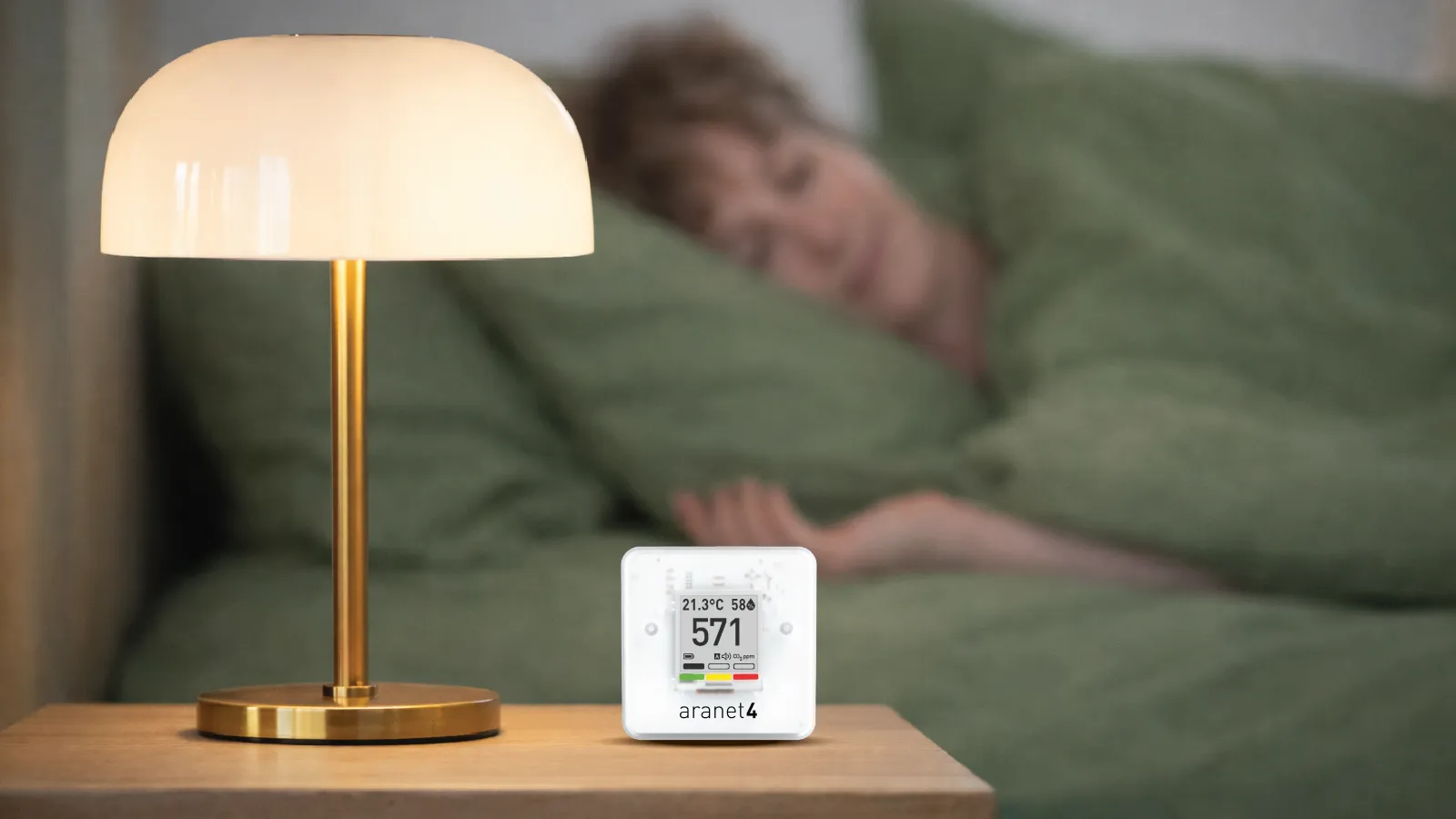
The first step is observing what happens overnight. Measuring CO2 levels in the bedroom can reveal how the air changes while you sleep. You might discover that the concentration gradually rises through the night when the room remains closed.
The second step is observing your workspace during the day. Measuring CO2 levels in a home office or meeting room often shows similar patterns, especially during long work sessions or calls with the door closed.
When you compare these environments, patterns often become clear. The goal is not to complicate daily life but to understand the system in which your brain operates every day.
Let’s Wrap up
If you regularly notice that you have a good sleep score but are tired during the day, the explanation may not lie entirely inside your body.
Your wearable already measures your physiology. It tracks heart rate, movement, and sleep stages with impressive detail. But it cannot measure the air that surrounds you while you sleep and think.
Sometimes the missing variable is environmental rather than biological.
Measuring the air in the places where you spend the most time thinking and recovering may reveal patterns your sleep score cannot see.
Item 1 of 1
Aranet4 HOME
Designed for bedrooms, home offices, and classrooms, Aranet4 HOME helps you identify poor ventilation and rising CO2 levels throughout the day and overnight.