United States (USA) (English / USD)

November 06, 2026
Yes, There Is Radon in Europe
If you’re reading this, you probably know what radon gas is and why we don’t want it in our buildings. (In case you don’t, start with our radon explainer.)
But, even if you’ve followed the topic, you might not be fully aware there is radon in Europe, too. It might sound silly - of course, radon can be present in all corners of the world, but when we talk about radon, we reference the EPA, Government of Canada, perhaps the WHO. European sources and cases? Not so much - because there's a lot fewer of those.
So, as European Radon Day on November 7 and World Ventilation Day on November 8 approach, let’s take a look at Europe. Because the truth is, there is plenty of radon in Europe, and we can’t assume we’re safe from it, even if we did build a great, great wall like our overseas neighbors.
What Are the Radon Levels in Europe?
So, is there as much radon in Europe as elsewhere?
Yes. Actually, more! While the European average is 77 Bq/m³, the population-weighted worldwide average is 53 Bq/m³. Even when you take the atypical numbers out, the European mean is higher.
That’s about 40-45% higher in Europe!
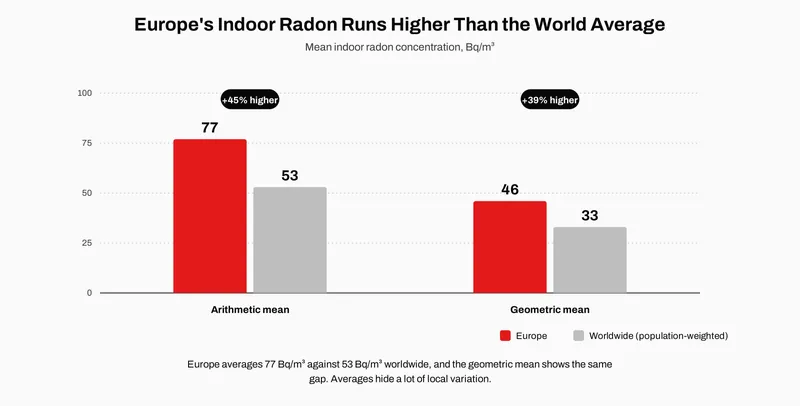
Source: United Nations Scientific Committee on the Effects of Atomic Radiation (UNSCEAR)
There’s a caveat, though: radon in Europe isn’t evenly spread. Some countries and regions have more of it, some have less.
And, even within a region, there can be spikes in one place and lower numbers in another. That’s true in Europe and worldwide.
Which European Countries Have the Highest Radon Levels?
If you look at the national average indoor radon levels in Europe, the top three countries, according to UNSCEAR, are:
- Republic of Moldova (253 Bq/m³),
- Armenia (177 Bq/m³),
- and Poland (165 Bq/m³).
But an average doesn’t tell you much about your area.
Why?
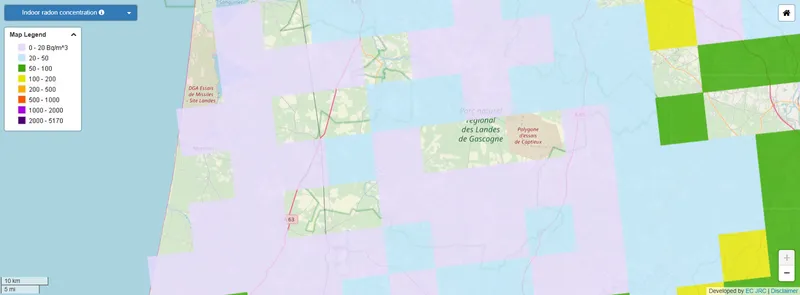
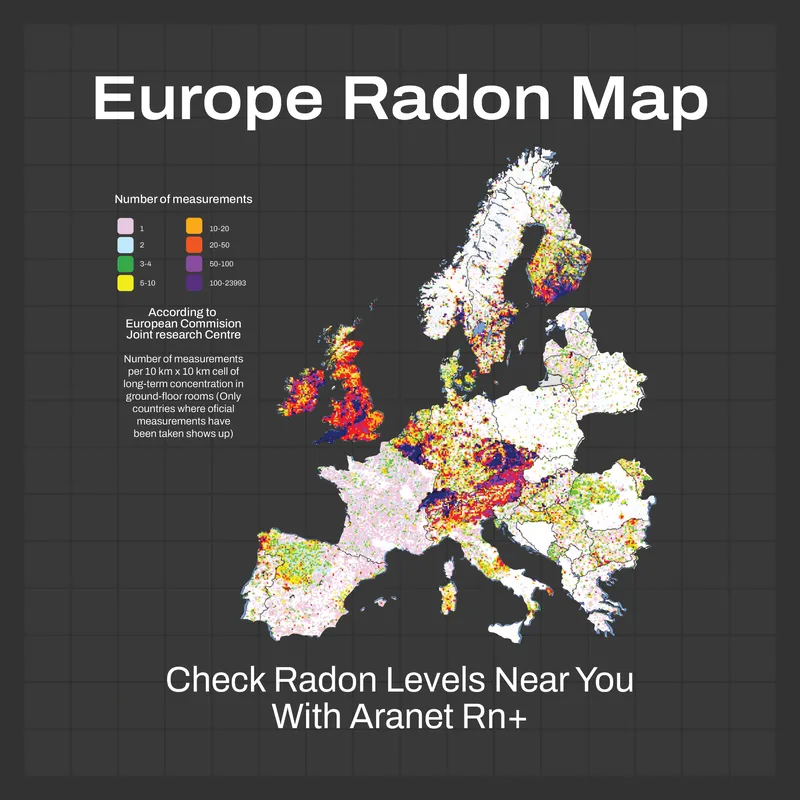
Take France in the European Map of Indoor Radon Concentration, for example.
Zoom in and you’ll see the Landes de Gascogne Regional Nature Park in light blue and lavender. That means average radon there is below 50, or even below 20 Bq/m³.
Now look at the Millevaches Regional Nature Park in Limousin. It’s a bit of a rainbow, with levels from 50 to a staggering 5170 Bq/m³!
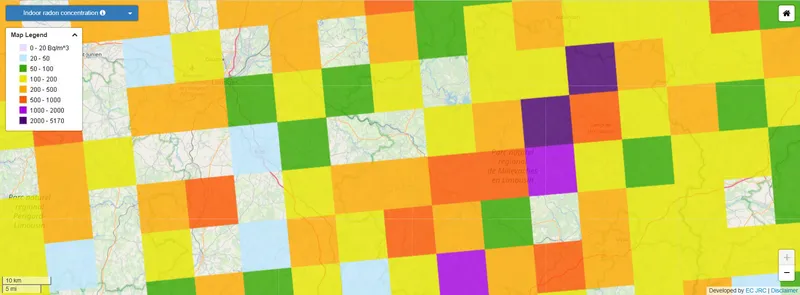
And even this map can only zoom so far. Its smallest square is 10x10 kilometres, so there’s still room for more variation inside it.
So which end of the range is your home on? A map can tell you where radon is more likely. It can’t tell you what’s happening in your basement or living room.
Why Does Radon Vary Geographically?
Radon forms underground.
It comes from uranium in soil and rocks, so what’s under your feet decides how much radon you start with. Granite, shale, phosphate, and volcanic rock tend to have higher radon potential.
Then there’s the ground itself. Permeable soil, with small openings like pores, cracks, and cavities, lets radon gas rise more easily than, say, dense clay layers.
And that’s not it, either.
The building matters too. Radon-resistant construction features like a sealed basement and a soil depressurization system can significantly lower indoor radon concentration. So can properly maintained ventilation.
That’s why houses right next to each other can have very different radon levels. One might have a problem, the other might not.
How to Find Out If Your Home Has Radon
Knowing if your house has elevated radon levels could save your life.
That’s because radon is the second leading cause of lung cancer, and in Europe it’s estimated to have been behind around 19,000 lung cancers in 2019.
You can’t see, smell, or taste radon, so the only way to know if (and how much) your home is affected is to measure.
You could check your country’s official guidelines on when to measure and for how long. The WHO’s rule of thumb is at least three months to get a proper annual average.
If you live somewhere with cold winters, measure then. You open windows less, seal every nook and cranny, and radon builds up.
One short test can miss a lot, because radon varies from day to day and season to season. A continuous monitor shows you the whole picture.
When should you worry?
EU countries have to set national reference levels of no more than 300 Bq/m³.
However, the WHO recommends keeping indoor radon below 100 Bq/m³, as every additional 100 Bq/m³ of long-term exposure raises lung cancer risk by about 16%.
If your result is higher, ventilate and talk to a radon specialist about mitigation.
So if you want to know where you stand, there’s literally no time like the present. Aranet Radon One and Aranet Radon Plus will help you with it.
Your home is your safe space. It’s worth knowing it’s keeping you safe from radon, too.
FAQ
Is there radon in Europe?
Yes. The average indoor level is about 77 Bq/m³, higher than the worldwide average of 53.
How do I check radon at home?
Measure for at least three months, ideally through the colder season, and use a continuous monitor if you want to see changes over time.
What is a safe radon level in Europe?
The WHO recommends keeping indoor radon below 100 Bq/m³. EU countries have to set national reference levels of no more than 300 Bq/m³, so the “acceptable” number depends on where you live. Lung cancer risk goes up with exposure, so lower is better.
Does ventilation reduce radon?
It can help. Properly maintained ventilation lowers indoor radon, but the only way to know how much is to measure before and after.
Know Where Your Home Stands
A map can tell you where radon is more likely, but only a measurement tells you what’s happening in your own home. Aranet Radon One and Radon Plus track radon continuously, so you see the whole picture, not a single snapshot.
