United States (USA) (English / USD)

September 09, 2026
Building a New Home? Design Radon Out Before Pouring the Concrete
So, you're building a house.
And considering how much time, money, and thought goes into building a house, you probably want to get the important things right from the start. No costly surprises after moving in.
Radon is one of the things worth thinking about before you build. Even a brand-new home can have elevated radon levels if the gas finds its way in through the foundation and other openings.
The good news?
When you're building from the ground up, you have a chance to address radon before it becomes a problem. This might also help you avoid a more complicated retrofit later.
That means thinking about your foundation, radon-resistant construction, radon testing, and continuous radon monitoring from the start.
Here's what to consider before you break ground.
Can a New Home Have Radon?
Can a brand-new home have radon? Yes, it absolutely can.
You might think radon in new construction wouldn't be a problem because all the potential entry points for gases like radon would be sealed.
The truth is more complicated.
Even new houses can have small cracks and holes that allow radon to enter.
The risk can be greater if the house wasn't designed with radon-resistant construction in mind.
And even if you've made sure to build or buy a home with radon-resistant construction, the radon levels in your house also depend on how uranium-rich the soil under your new home is.
If radon levels in your area are high, it's possible that just sealing the cracks won't be enough.
This is why the World Health Organization (WHO), the United States Environmental Protection Agency (EPA), and the Government of Canada all recommend radon testing even for newly built houses.
Can You Have Radon Without a Basement?
What if the house you're building doesn't have a basement? Should you still think about radon-resistant construction?
The short answer is yes.
Basements can have higher radon levels because they are surrounded by soil. But homes without basements can still have radon. Radon in homes without basements often comes through a slab-on-grade foundation or crawlspace instead.
That's because the source of indoor radon is the soil underneath the building. Whether your house has a slab-on-grade foundation or a crawlspace, parts of the building are still in direct contact with the earth.
This means there can still be plenty of pathways for radon to enter your home.
How Does Radon Get Into a House?
So, where does radon come from and how does it get into a house?
Radon is a naturally occurring radioactive gas produced when uranium in rock, soil, and groundwater breaks down.
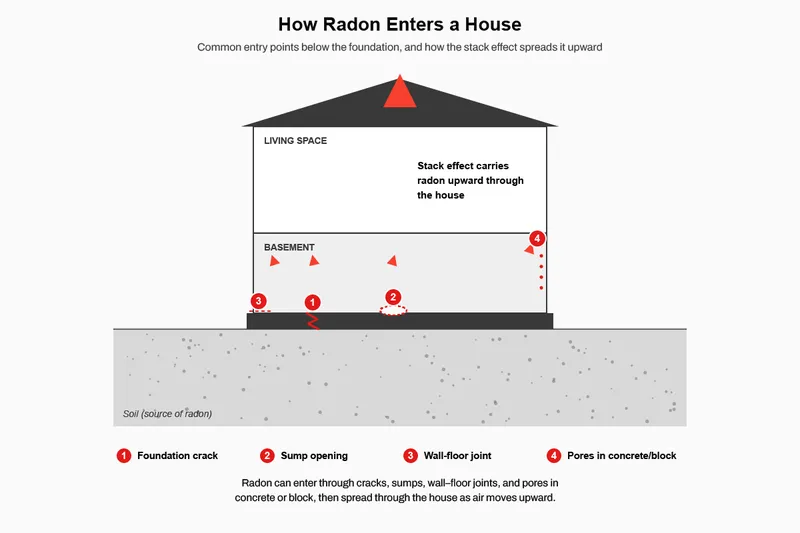
Radon gas can then enter a house through:
- cracks or holes in the foundation,
- openings around plumbing penetrations or sumps,
- unsealed connections between walls and floors,
- and even pores in materials like concrete or bricks.
Outdoors, radon usually disperses quickly in fresh air. Indoors, it can accumulate without you being able to smell, taste, or sense it. At higher concentrations, it can pose significant health risks and lead to lung cancer.
Differences in air pressure between the house and the surrounding soil can also draw radon into the building. This can create negative pressure inside the house, which draws in air from the surrounding soil that may contain radon and other soil gases. (EPA)
Then, the stack effect comes into play.
The stack effect can contribute to the movement of the radon-containing air through the house. As a result, radon that enters at lower levels can spread to other parts of the building.
Can You Tell If an Area Has High Radon Levels?
You can get a general idea of the radon levels by area.
A good place to start is your country or region's radon risk map:
- The EPA's Radon Map for the USA (Zones by County),
- The official Radon Map of Canada,
- UK Radon Map,
- European Indoor Radon Map.
If you're building in a high-radon area, you should incorporate radon-resistant features from the start.
But what if you're building in a low-to-moderate radon-risk area?
You should still look into it.
That's because a radon map shows the general risk across a region, but individual homes can still have considerably different radon levels.
You can also consult more local radon data or ask your neighbors whether they've had their homes tested.
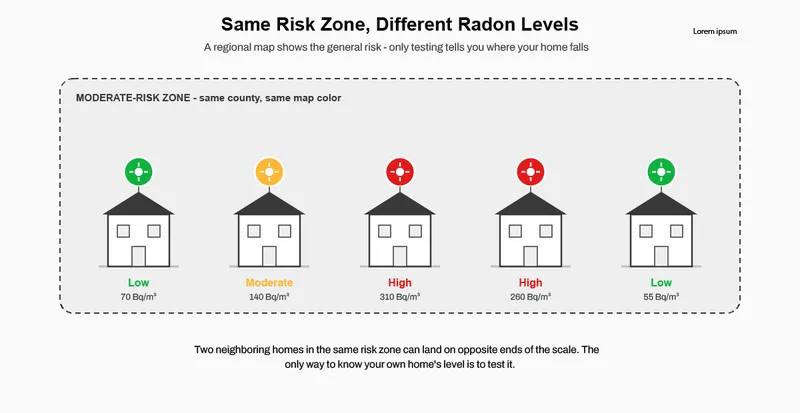
However, the only reliable way to know whether your new house has elevated radon levels is to test it. Health authorities recommend radon testing even for homes with built-in radon-resistant features. (EPA, WHO, CCSR)
Radon levels in a home can vary from season to season and sometimes even from hour to hour, depending on weather conditions. That's why the best way to assess the risk is to measure radon levels in your new home for at least three months during the heating season.
How To Build a Radon-Resistant Home?
If you're building a new home, the best time to think about radon is while you're still in the planning phase. You don't necessarily need to become an expert in foundation construction. But there are a few things worth discussing with your builder before the concrete goes in.
The exact measures depend on the type of foundation you're building. But the basic idea is simple: create a barrier between the house and the soil underneath it and make it difficult for radon to find a way inside.
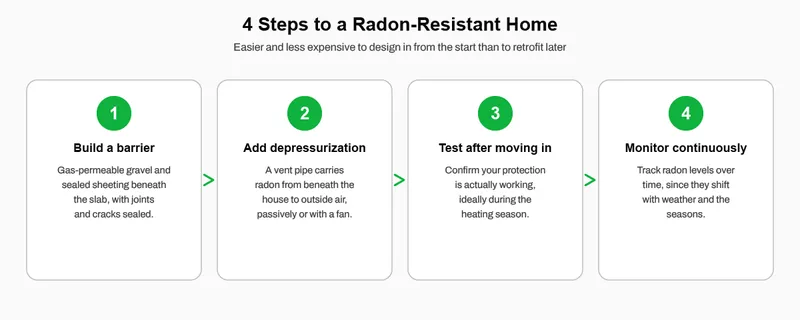
This can include a gas-permeable layer of gravel beneath the slab, sealed plastic sheeting, and sealed joints, cracks, and other potential entry points.
These measures aren't only useful for radon. They can also help keep moisture, other soil gases, and pollutants out of the home, and reduce the risk of mold and mildew.
Another radon-resistant feature worth discussing with your builder is a soil depressurization system.
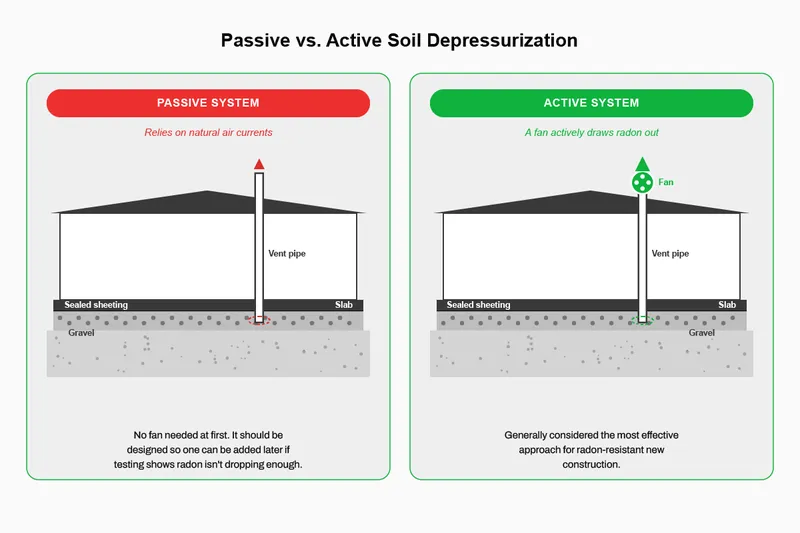
A passive soil depressurization system uses a vent pipe to carry radon from beneath the house and release it safely outside. It should be designed so that a fan can be added later if testing shows that the passive system isn't reducing radon enough.
An active soil depressurization system works on the same principle, but uses a fan to actively draw radon from beneath the house and vent it outdoors. It is generally considered the most effective approach for radon-resistant new construction.
Planning for radon-resistant construction from the start is much easier and less expensive than trying to retrofit it later.
How Do I Know Radon Protection Is Actually Working?
Let's take a moment to imagine that you're finally moving into your brand-new house.
First of all, congratulations! After all the planning, decisions, and work that went into building it, it's time to settle in and enjoy it.
But while you're doing that, there should be one more thing happening in the background: radon testing.
As mentioned before, radon testing is the only way to know whether the protection measures in your new home are working as intended. Consider testing after you move in, and again during the heating season for at least three months if your first test doesn't take place then.
But exactly what radon level should you aim for?
Different health authorities use somewhat different reference or action levels:
- 100 Bq/m³ (approximately 2.7 pCi/L): the WHO recommends that countries set a reference level no higher than this where possible, or no higher than 300 Bq/m³ (~8.1 pCi/L) where 100 Bq/m³ isn't achievable.
- 4 pCi/L (approximately 150 Bq/m³): the EPA recommends taking action to reduce radon at or above this level, while considering action between 2 and 4 pCi/L.
- 200 Bq/m³ (approximately 5.4 pCi/L): the Government of Canada recommends taking corrective action above this level.
Although the recommended action or reference levels differ depending on where you live, one thing is clear: there is no known safe level of radon exposure. The goal is to keep radon levels as low as reasonably achievable, and make sure they stay that way.
Once you know your home's radon levels, continuous radon monitoring can help you keep track of how they change over time.
Keeping a radon monitor like Aranet Radon One or Aranet Radon Plus at the lowest lived-in level of your house can help you see whether your radon protection continues to perform as expected.
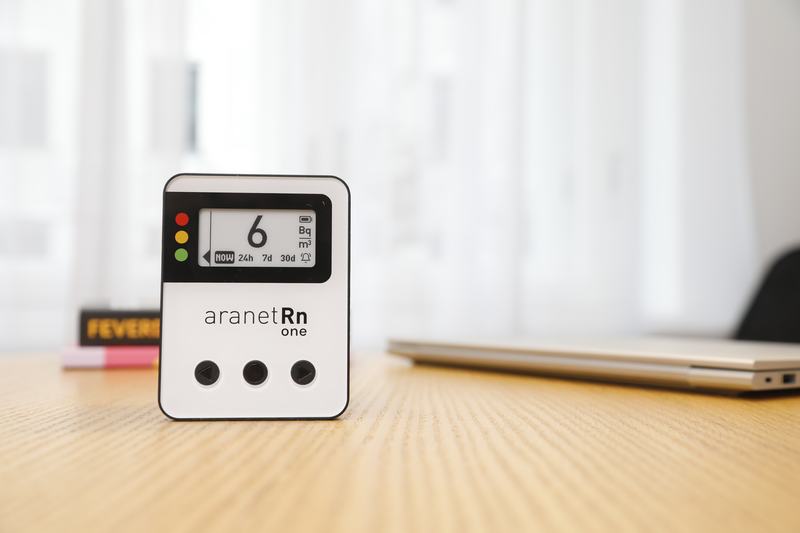
In our recent Buyer's Guide With Independent Accuracy Data, Aranet Radon Plus ranked as the best overall continuous home radon monitor, while Aranet Radon One ranked as the best budget option.
Building a home is a big investment, and radon may not be the first thing on your mind when you're choosing a foundation or planning your construction. But thinking about radon early can make it much easier to protect your home, family, and finances.
With the right construction measures and ongoing monitoring, you can have one less hidden risk to worry about. And, of course, get on with enjoying your new home.
Don't Just Build It Right - Confirm It
Radon testing is the only way to know if your new home's protection is actually working. Aranet Radon One and Radon Plus give you continuous, real-time readings, not just a one-time snapshot.